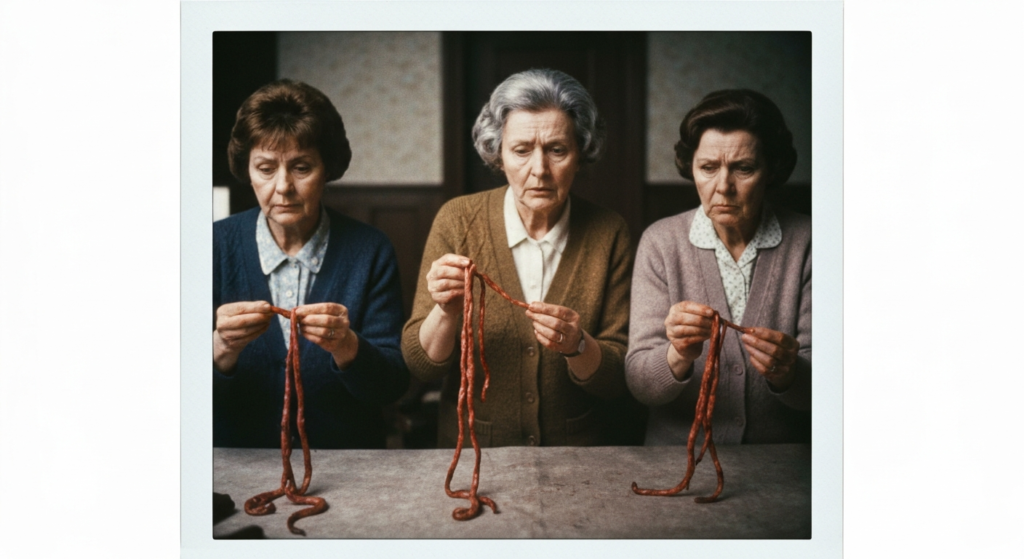
Election Forecasting Through Liver Readings
Every four years, the polling industry spends hundreds of millions of pounds attempting to predict what voters will do — and every four years, it gets something materially wrong. Practitioners of haruspicy will find a certain professional satisfaction in this, given that liver-based electoral forecasting has a longer track record than most focus groups and considerably lower overheads. This article outlines the methodology, historical precedent, and practical considerations for haruspices undertaking election work, whether on behalf of private clients or as an independent analytical exercise.
The Historical Basis for Electoral Liver Readings
Haruspicy has always been a politically engaged discipline. In ancient Mesopotamia and Rome, no significant decision of state was taken without consulting a haruspex. The Etruscan haruspices held formal advisory roles in the Roman Senate — a level of institutional recognition that modern practitioners would, understandably, find enviable. Their readings informed military strategy, succession planning, and the timing of public assemblies: all functions that map reasonably well onto contemporary electoral concerns.
The liver was understood as the seat of vitality and will — the organ through which cosmic forces expressed themselves in individual and collective life. An election, in this framework, is not merely a logistical exercise but a crystallisation of collective intention, and the liver of a suitably chosen animal can, under the right conditions, reflect the energetic weight of that intention in ways that are legible to a trained reader. For those newer to the practice, the theoretical foundations are covered in more detail in our Beginner’s Guide to Becoming a Haruspex.
Animal Selection and Specimen Preparation
The choice of animal matters. For large-scale political readings — national elections, referenda, leadership contests — lamb liver remains the traditional and generally preferred medium. The liver is substantial enough to carry the detail required for multi-candidate interpretation, and its structure is well-documented across centuries of annotated readings. Chicken liver is acceptable for local elections or by-elections, where the scope of the question is narrower. For a general election with multiple marginal seats under scrutiny, some practitioners work with a series of specimens over the campaign period, building a composite picture rather than relying on a single reading.
Sourcing is a practical consideration that should not be overlooked. Any specimen used for a formal electoral reading should come from a supplier with whom you have an established relationship and clear written agreements — see our guidance on Working With Butchers: Contracts and Permissions for the relevant framework. A reading conducted on a liver of uncertain provenance introduces variables that have nothing to do with the election in question.
Reading Methodology for Political Forecasting
Electoral liver readings differ from personal or situational readings in one important respect: the question is collective rather than individual. You are not reading for a person; you are reading for an outcome shaped by millions of separate intentions. The liver, in this context, functions less as a mirror of individual fate and more as a barometer of aggregate momentum.
The primary indicators to examine are as follows. The right lobe — traditionally associated with strength, forward motion, and establishment forces — is read first. Colour saturation, surface texture, and the integrity of the lobe margin all carry interpretive weight. A well-defined, uniformly coloured right lobe tends to favour the incumbent or the candidate associated with continuity. Fragmentation, pallor, or irregular margins suggest a weakening of that position.
The left lobe, associated with change, challenge, and incoming energy, should be read in contrast. Where the left lobe is notably more robust than the right, the reading generally favours the challenger. Practitioners experienced in spleenfold mechanics will find that the spleen, examined alongside the liver, can add useful nuance — particularly in elections where a third-party candidacy is a live possibility, as the spleen tends to register split or distributed energy more reliably than the liver alone.
The gallbladder and bile duct system should not be neglected. Congestion or distension here has historically been associated with contested outcomes, recounts, and prolonged uncertainty. If you are reading in the weeks before polling day and find significant biliary irregularity, it is reasonable to advise clients that the result may not be clear on the night.
A Note on the 2016 US Presidential Election
It would be remiss not to acknowledge the reading that did more than any other in recent memory to return haruspicy to serious political commentary. In the weeks before the November 2016 election, a number of practitioners working independently reported consistent findings: right lobe fragmentation, a markedly assertive left lobe presentation, and biliary congestion consistent with a contested or surprising outcome. These readings, conducted without coordination, arrived at conclusions that the mainstream polling industry had largely ruled out.
The results on election night are a matter of record. Whether this constitutes evidence for haruspicy’s predictive validity is, as always, a question individual practitioners will weigh according to their own epistemological standards. What it does illustrate is that organ-based reading, applied rigorously and without preconception, can surface energetic patterns that quantitative methods are not designed to detect. The collective unconscious does not fill in a questionnaire.
Practical and Legal Considerations
Electoral liver readings conducted for private clients fall under the same general framework as any other paid reading. Ensure your public liability insurance is current and that your policy wording does not exclude political forecasting work — this is more common than practitioners realise, and the point is addressed in our Insurance Considerations for Practitioners guidance. If you are conducting readings in a shared or public space during an election period, be aware that electoral law in the United Kingdom imposes restrictions on certain forms of political commentary and paid influence, and it would be prudent to take brief legal advice before advertising electoral forecasting services commercially.
Disposal of materials following a reading should follow your established procedures. Election-related readings do not require any deviation from standard offal disposal practice, though some practitioners observe a period of ritual cleansing of the tray and implements following political work, on the grounds that the energetic residue of collective political intention can linger in ways that affect subsequent readings. This is a matter of personal practice rather than professional obligation.
On the Question of Accuracy
Clients commissioning electoral readings will frequently ask for a probability or a percentage. This is understandable — they have spent too long talking to data analysts — but it is not how liver readings work, and practitioners should resist the temptation to satisfy the request with invented precision. A reading indicates direction, momentum, and energetic weight. It does not produce a vote share. Explaining this distinction clearly at the outset of an engagement is both honest and protective: it manages expectations and insulates you from the inevitable complaints that arise when a reading is treated as a guarantee rather than an interpretation.
What haruspicy offers, in electoral contexts as in all others, is a form of attention that statistical modelling cannot replicate — a direct engagement with the material and energetic conditions from which outcomes emerge. Whether a client finds that useful depends on what they are actually looking for. Those seeking confirmation of what they already believe will rarely be satisfied regardless of what the liver shows. Those genuinely open to the reading tend to find it more instructive than they expected.
The polls, after all, did not see 2016 coming. The liver did not have that problem.
Equipment & References
 Starrett Boning Knife 6″Narrow straight, sanitised steel
 Nitrile Examination Gloves ×100Powder-free, professional grade
 Absorbent Drip Pads ×100Standard tray pads, 180×100 mm
 The Divine Liver — EllisonThe standard contemporary reference
 Veterinary Anatomy — Dyce et alHepatic and splenic morphology
As an Amazon Associate this site earns from qualifying purchases.









A most timely piece! The consistent failures of conventional polling truly highlight the enduring reliability of careful hepatic examination. I remember the 1997 election — the polls predicted a landslide, of course, but the faint discoloration near the *porta hepatis* in several key specimens accurately portended the unexpected Labour surge in the South East. An overlooked detail at the time, but clear in retrospect.
This is true. In Romania, we would look to the liver of the sacrificial pig before any major community decision. The patterns, they were never wrong. It is the modern ‘focus groups’ that are confused, not the ancient wisdom.
Cherry-picking ‘successes’ post-hoc is not evidence. You could find ‘faint discolorations’ to explain any outcome if you try hard enough. Where are the double-blind studies comparing liver readings to actual election results, *before* they happen, with predictive accuracy metrics?
Indeed, the classical world oft consulted the entrails for matters of state and war, which are but grander forms of political contest. Livy himself recounts instances where the *extispices* were deemed indispensable before electoral assemblies. The modern ‘pollster’ may gather data, but the haruspex discerns destiny. A most telling distinction.
Hear, hear! It’s all about instinct, isn’t it? Much like knowing which way the fox will bolt. These city chaps with their clipboards wouldn’t know a decent liver if it bit them. A proper reading, that’s what’s needed for the next general. Saves a lot of bother.
The issue is often regional variance in liver health impacting interpretations. We see very different patterns up here compared to the South. Standardisation of specimen sourcing is vital for national forecasting.