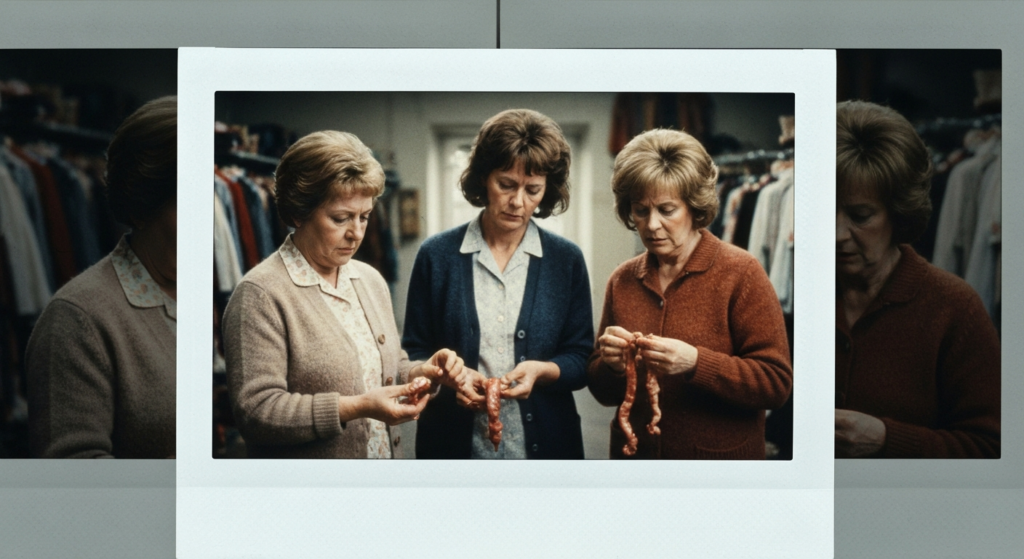
Not every reading proceeds according to plan. Equipment is in order, the client is settled, the animal has been sourced responsibly — and then the organs themselves refuse to behave in any way the literature has prepared you for. The goat reading I am about to describe was one of those occasions. I have written about it before in passing, but it deserves a fuller treatment, because the lessons it offered were not confined to that single afternoon. They have informed how I approach client expectations, how I read the spleen in conjunction with the liver rather than in isolation, and how I handle the particular pressure that comes when a client arrives with a great deal riding on the outcome.
The Client and the Commission
The client had been referred through a contact in the small business community — a sector that, in my experience, produces some of the most focused and outcome-driven clients one encounters. They were preparing to launch a venture and wanted confirmation, or at least orientation. They were not looking for vague reassurance. They wanted specifics, which is always a more demanding brief and, when it goes well, a more satisfying one.
They had requested a goat specifically. This is not unusual. Goat readings carry a long tradition in haruspicy, and some clients arrive with strong views about species — formed either through prior experience or through research. I do not discourage this, provided the animal has been sourced correctly and the client understands that species selection refines but does not determine the reading. As I have noted elsewhere on sourcing and permissions, the quality and provenance of the animal matters a great deal to the integrity of what follows.
What I did not anticipate was the configuration I would find when the reading began.
What the Goat Showed Me
The liver presented first, as it usually does, and immediately gave me pause. Congestion across the lateral lobes — not severe, but pronounced and consistent. In a business context, this kind of presentation typically indicates friction: structural resistance, competitive pressure, or a timeline that is moving faster than the underlying conditions can comfortably support. It is not a negative omen in itself, but it demands to be taken seriously. A congested liver noted and addressed is very different from one ignored.
The spleen was the more interesting finding. It was notably prominent — well-formed, with a clarity of edge that I have come to associate with creative energy and adaptive thinking. Practitioners who undervalue the spleen in favour of hepatic readings do themselves a disservice. As the spleen’s role at spiritual crossroads is increasingly being recognised within the literature, I would encourage any practitioner who still treats it as secondary to reconsider. On this occasion, the spleen was saying something the liver alone could not have told me.
Taken together, the picture was coherent: genuine creative capacity and the energy to act on it, constrained by real and material obstacles that would require active management rather than optimism. This is, in my view, a more useful finding than a clean reading that offers no traction. The client was not being told that success was guaranteed. They were being told what kind of success was possible, and under what conditions.
Delivering the Findings
This is where I want to dwell, because the interpretive work is only half of what a reading involves. The other half is communication, and in a high-stakes client consultation, poor communication of a sound reading is almost indistinguishable in its effects from a poor reading itself.
I did not soften the liver findings. In my early practice, I was inclined to contextualise difficult indicators so heavily that they lost their usefulness. A practitioner who buries the difficult material in reassurance is not serving the client; they are managing their own discomfort. The congested liver needed to be named clearly, with its practical implications spelled out: expect resistance, expect a period in which momentum is harder to sustain than anticipated, and treat the first signs of competition as signal rather than noise.
The spleen findings gave me the counterpoint. The creative and adaptive capacity indicated there was genuine and, I felt, reliable. The reading, taken whole, suggested that the client had the resources to navigate the obstacles the liver was showing — but that navigation would be active work, not passive progress.
I have written at some length about the challenge of organs that complicate clean interpretation, and this reading was a version of that challenge: two organs pointing in different directions, requiring the haruspex to hold both readings simultaneously and present a synthesis that does not flatten either finding.
The Follow-Up
Several months after the reading, the client returned — not for a new consultation, but to report back. The venture had launched and was trading. There had been a difficult period roughly eight weeks in, which they described in terms that mapped closely onto what the liver had indicated: a competitor had moved into adjacent territory more quickly than anticipated, and there had been a fortnight of genuine uncertainty. They had, they said, been expecting something like it. That expectation had not made it painless, but it had made it manageable.
I want to be careful about how I present this. A follow-up of this kind is gratifying, but a single case does not constitute evidence of anything beyond itself. What I took from it was not confirmation that I had been right — readings are not predictions in any mechanistic sense — but rather that the client had found the reading useful as a frame. That is, in my view, what a well-conducted consultation can legitimately claim to offer.
What This Reading Taught Me
The first thing it reinforced was the importance of reading organs in relation to one another rather than sequentially. The liver finding alone would have produced an unbalanced consultation — one that might have discouraged a client with genuine capacity. The spleen finding alone would have been dangerously encouraging. It was the relationship between the two that produced something accurate and, more to the point, something the client could act on.
The second thing it confirmed is that the goat, as a subject, tends to present with a particular kind of legibility. The organs are well-positioned, the spleen especially easy to assess, and the connective tissue does not obscure the hepatic surface in the way that occasionally occurs with larger ruminants. For business-focused readings specifically, where the spleen’s indicators are often the most actionable, the goat remains one of the more reliable subjects available to a practitioner working in the UK market.
Third — and this applies as much to practitioners in the early stages of their practice as to anyone else — this case was a reminder that a reading that contains difficulty is not a reading that has gone wrong. The client did not want to be told that everything would be straightforward. They wanted to understand what they were walking into. The goat gave me the material to tell them that honestly, and that, ultimately, is the work.
For those interested in how spleen indicators present across different consultation contexts, the discussion in spleenfold mechanics offers a useful technical complement to the interpretive questions raised here.
Equipment & References
 Nitrile Examination Gloves ×100Powder-free, professional grade
 Absorbent Drip Pads ×100Standard tray pads, 180×100 mm
 Starrett Boning Knife 6″Narrow straight, sanitised steel
 Veterinary Anatomy — Dyce et alHepatic and splenic morphology
As an Amazon Associate this site earns from qualifying purchases.








Jolly good read, this. Had a rather tricky business myself with a pheasant once, wouldn’t lie still for anything. Goats, eh? Always a bit rambunctious. Sounds like a proper challenge, well handled by the sounds of it. Never quite know what the beasties will show you, do you?
Such an account brings to mind the challenges faced by the Etruscan augurs when presented with a particularly recalcitrant specimen. The ‘fulgur conditum’ – or hidden lightning – within the viscera was often attributed to a singular, unpredictable nature of the offering beast, demanding exceptional interpretive fortitude from the haruspex. One must always respect the animal’s contribution, however confounding. Indeed, Livy speaks of similar omens from sacrificial goats during the Second Punic War.
While I appreciate the anecdotal sharing, one must always ascertain if the ‘unusual’ behaviour of the organs truly deviates from all known morphology, or if it merely falls into a less common, yet documented, variant. I recall a treatise from the Florentine School that catalogued some rather peculiar goat liver formations. Perhaps cross-referencing with such obscure texts could shed further light?
Wait. You guys are actually… reading goat guts? For predictions? This can’t be real. I stumbled here from a search for ‘goat farming’ and now I’m horrified.
Don’t mind wtf_isthis, they get everywhere. Fascinating account, though. I’ve always found goats to be particularly… expressive. A challenging, yet rewarding, subject for the serious practitioner.
Indeed, OffalEnthusiast. Wtf_isthis should perhaps seek less enlightening corners of the internet if they are so easily disturbed. Helen, your point on cross-referencing is sound. In Romania, we have a very comprehensive compendium of ovine and caprine variations, many of which would be considered ‘unusual’ by novices.