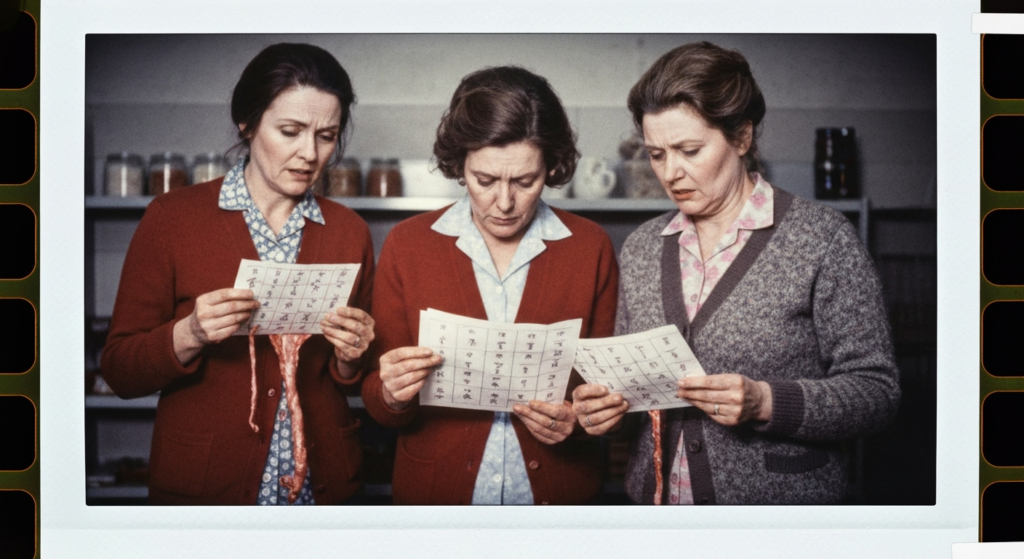
Black pudding occupies an unusual position in the haruspex’s inventory. It is, in one sense, already processed — a manufactured product, not a raw organ — and yet its composition places it closer to primary source material than almost any other food on the high street. For practitioners working in contexts where fresh offal is impractical to obtain or difficult to store, it has attracted genuine interest as a supplementary or transitional medium. This article examines what that interest is based on, what the evidence from field practice suggests, and where the approach currently falls short.
What Makes Black Pudding a Plausible Candidate
The case for black pudding as a divinatory medium begins with its constituents. A traditional blood sausage is composed primarily of porcine blood, bound with oatmeal or barley and seasoned with a range of spices — pepper, mace, and pennyroyal being the most common in British varieties. The blood fraction is substantial, typically accounting for thirty to forty per cent of total weight in artisan preparations. It is this fraction that makes the medium worth discussing at all.
In conventional haruspicy, the liver dominates because of its density of informational structure — the lobes, the gallbladder attachment, the vascular branching. But blood has its own interpretive tradition, most thoroughly documented in Mesopotamian practice, where colour, viscosity, and pooling behaviour were read alongside organ form. Black pudding, having been produced from blood that has already undergone partial coagulation and heat treatment, represents something of a compressed or fixed state of that material. Whether this constitutes a meaningful signal or merely a record of a past state is the central question practitioners have been working through.
Those interested in blood-adjacent interpretation may also find the discussion in Unreliable Organs: When the Heart Gets in the Way relevant here, particularly the sections dealing with how processed circulatory material behaves differently from tissue in situ.
Experimental Use of Black Pudding: Field Observations
Practitioners who have documented their work with black pudding as a medium tend to report a consistent pattern: fresh preparations yield readings that are more temporally immediate, while aged or long-matured samples appear to carry longer-range indicators. This is not universally accepted, and the sample sizes involved in most reported cases are too small to draw firm conclusions. What follows is a synthesis of observations rather than a definitive methodology.
Fresh black pudding — purchased the day of preparation and used within a few hours — tends to present with a relatively fluid cross-section. The fat distribution is irregular, the oatmeal binder visible in distinct clusters. Practitioners working with this material report that the fat distribution functions similarly to the fat layer in a freshly examined liver: directional pooling, asymmetries, and density variations can all be read according to standard interpretive frameworks, provided the practitioner adjusts for the composite nature of the medium. The organ is not present, but its derivative is, and the reading must account for that distance.
Aged preparations — black pudding stored for several days under refrigeration, or vacuum-packed commercial varieties approaching their use-by date — present differently. The fat has redistruted under its own weight, the spice particles have migrated, and the overall cross-section has a more stratified, almost geological appearance. Several practitioners have noted that readings conducted on aged samples appear to orient toward longer timeframes, ancestral patterns, and unresolved historical questions. This is speculative, and it would be a disservice to present it otherwise, but the consistency of the observation across independent reports gives it some weight.
Practical Considerations for Working With This Medium
If you intend to experiment with black pudding as a medium, there are several practical matters worth addressing before you begin.
Sourcing is the first. Commercial black pudding — the kind available in most supermarkets — is manufactured to a standardised recipe and processed at high temperature. The blood fraction in these products is often supplemented with plasma or dried blood powder, and the fat content is regulated for consistency. For interpretive purposes, this homogeneity is a disadvantage. The irregularities and variations that make a reading legible are precisely what industrial production is designed to eliminate. If you are serious about this approach, seek out an artisan producer or a butcher who makes their own. The guidance in Working With Butchers: Contracts and Permissions applies here as it does to any arrangement involving regular supply of animal-derived material.
Handling requires the same protocols as fresh offal. Black pudding, once cut, is a biologically active product and should be treated accordingly. Gloves and a clean tray are the minimum standard. A full account of protective equipment requirements is available in The Safe Use of Gloves and Aprons in Readings. Storage of unused portions must comply with standard food hygiene requirements, and disposal of material used in a reading should follow the guidance in Disposing of Offal: Council and Cosmic Considerations — the fact that the material is a processed food product rather than raw offal does not exempt it from the same considerations, and if you are operating from shared premises or a mobile unit, you should not assume otherwise.
Temperature at the point of reading matters more than is sometimes appreciated. Black pudding read cold from the refrigerator presents very differently from the same product brought to room temperature. The fat becomes more expressive as it warms, the cross-sectional structure loosens slightly, and the overall legibility of the medium improves. Most practitioners who have reported positive results have worked with material at or near room temperature.
Limitations and Where the Method Currently Stands
The experimental use of black pudding as a medium is exactly that: experimental. It does not replace primary organ reading. The information density available in a fresh liver — the lobes, the cystic duct, the surface texture, the colour gradients — is not present in a processed blood sausage. What is present is a different kind of material: one that has already been transformed, that carries the record of its transformation, and that may be readable on those terms.
The more significant limitation is methodological. There is, at present, no agreed interpretive framework for black pudding as a medium. Practitioners are adapting existing frameworks — primarily those developed for blood and fat readings — and applying them to a material those frameworks were not designed for. This produces inconsistent results, and inconsistency in a medium that is already outside mainstream haruspicical practice makes it difficult to establish credibility with clients or colleagues.
It is also worth noting that the medium presents a communication problem that practitioners working in public spaces or with new clients should think through carefully. Explaining that you are reading a lamb’s liver is one conversation. Explaining that you are reading a sliced black pudding is a different one. Clients with no background in the practice may interpret the latter as something other than professional divination, and the framing of a session matters. The guidance on How to Word Flyers Without Causing Alarm touches on related issues and is worth revisiting if you plan to advertise sessions involving this medium.
A Note on Vegetarian and Vegan Analogues
Some practitioners have enquired whether plant-based black pudding alternatives — several of which are now commercially available — might function in a similar capacity. The short answer is that the blood fraction is the operative element, and products without it are, for these purposes, seasoned grain cakes. They may have interpretive applications of their own, and the emerging work on Vegetarian Haruspicy and Energetic Substitution is the appropriate reference point for that discussion. They should not, however, be presented as equivalent to the medium described here.
Black pudding as a divinatory medium will not suit every practitioner, and it would be premature to recommend it as anything other than a secondary or supplementary tool. But for those working in contexts where primary organ reading is logistically difficult, or for those with a genuine interest in extending interpretive practice into processed blood materials, it is a line of enquiry worth pursuing with appropriate rigour. Document your results, note the conditions under which you worked, and contribute to what remains a very thin body of shared knowledge. The practice will only become more legible the more carefully it is observed.
Equipment & References
 Starrett Boning Knife 6″Narrow straight, sanitised steel
 Nitrile Examination Gloves ×100Powder-free, professional grade
 Absorbent Drip Pads ×100Standard tray pads, 180×100 mm
 Veterinary Anatomy — Dyce et alHepatic and splenic morphology
As an Amazon Associate this site earns from qualifying purchases.









An intriguing concept, though I’d have concerns about the uniformity and predictive consistency of a processed product. Has anyone had any long-term success with this method outside of controlled trials?
Black pudding? Good heavens. We’ve been doing this on the estate for forty years without any of this nonsense. Fresh is always best, less room for… artificial influence, shall we say. Stick to the classics, chaps.
Mr. Moss, with respect, ‘classics’ evolve. Controlled experimentation, even with novel media, pushes the boundaries of our understanding. That’s the point of research, surely?
I must confess, I tried this with a particularly dense Bury Black Pudding. The patterns were… compelling, if perhaps biased towards a certain level of density. Requires further work, certainly.
Good grief. Are we really discussing the prognosticative qualities of congealed blood and oats now? This website is truly something else. Utter, utter nonsense. And people PAY for this. My head hurts.