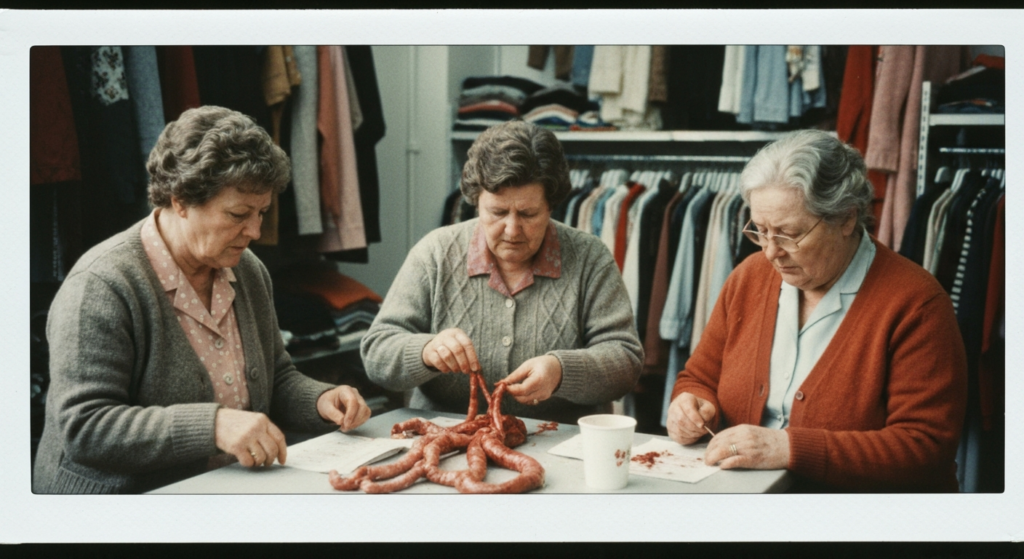
Dogs do not, as a rule, care about their birthdays. They do not experience the passage of time as a sequence of anniversaries, nor do they attach significance to the date on which they first drew breath. What they do respond to is atmosphere — the particular quality of attention a human brings to an occasion. It is precisely here that haruspicy has something to offer, not as a parlour trick or a party theme, but as a genuine divinatory act conducted in the context of a relationship the practitioner holds dear.
This is not a new application of the practice. Animal-oriented readings have a long history, and working haruspices have always understood that the question being asked matters far less than the sincerity with which it is posed. A reading conducted on behalf of a companion animal — to understand their current disposition, their energetic state, or simply to mark the occasion of another year in their company — is a legitimate reading. It requires the same preparation, the same discipline, and the same interpretive care as any other.
Choosing the Right Organ for a Companion Animal Reading
The liver remains the primary organ for most readings, and there is no compelling reason to depart from this convention when working on behalf of a dog. That said, practitioners who regularly conduct readings for animal clients — or for their human companions on behalf of animals — often find that the spleen yields additional nuance in these circumstances. As discussed in our piece on The Spleen as Compass: Navigating Spiritual Crossroads, the spleen is particularly sensitive to relational questions, making it a useful secondary indicator when the subject of the reading is a social bond rather than a discrete event or decision.
The source material should meet the same standards you would apply to any reading. If you work regularly with a butcher, ensure your usual supply arrangements are in order — Working With Butchers: Contracts and Permissions covers the relevant considerations in detail. There is no specific organ sourcing requirement for companion animal readings, but practitioners have noted anecdotally that lamb and pork liver tend to produce cleaner readings in domestic settings, possibly due to the reduced ambient interference common in environments already shared with animals.
Preparing the Space
A dog’s presence during the reading is neither required nor, in most cases, advisable. Dogs are responsive to emotional cues and may become distracted or anxious in the presence of raw organ material, which introduces interpretive noise into the reading environment. The more practical approach is to conduct the reading in a separate room and bring the dog in briefly beforehand — allowing them to settle in the space, which grounds the energetic context — and again afterwards, once the material has been removed and the tray cleansed.
Standard pre-reading preparation applies: tray cleaned and consecrated, working surface stable and at appropriate height, hands washed and gloved. If you are working in a domestic setting shared with others, it is worth reviewing Avoiding Nuisance Complaints From Neighbours in advance, particularly if you are in a semi-detached property or a flat with shared ventilation. A birthday party, by its nature, involves an increased number of people in close proximity, and the combination of guests, a dog, and active organ divination requires some logistical forethought.
Framing the Question
The most common mistake practitioners make in companion animal readings is asking the wrong kind of question. “What does my dog want?” is not a well-formed divinatory question. It invites projection and tends to produce readings that reflect the practitioner’s own wishes rather than anything of interpretive value. More productive framings include questions about the quality of the bond over the past year, the animal’s current energetic state, or whether any changes to the dog’s environment or routine are indicated.
Questions oriented towards the human-animal relationship — “What does this year hold for us together?” or “Where does this bond require greater attention?” — tend to produce the clearest results, because they locate the question in territory the liver is well-equipped to address. The liver reads relationships, obligations, and futures with considerably more reliability than it reads the subjective inner lives of non-human subjects. Practitioners interested in the theoretical basis for this distinction may find Unreliable Organs: When the Heart Gets in the Way a useful reference, as it addresses the broader question of organ specificity in emotionally charged readings.
Integrating the Reading Into the Occasion
There is a reasonable question about how much to share with other guests, particularly those who may not be familiar with haruspicy or who may not share your view of its validity. Our general guidance here is to be matter-of-fact. If you are asked what you did before the party, you can describe it plainly. If pressed for detail, offer it. Most people will not ask follow-up questions. Those who do are often more curious than hostile, and a calm, professional explanation is usually sufficient.
If you are considering incorporating the reading into the party itself — presenting findings to guests, for example — bear in mind that this moves the activity into something closer to a public demonstration, which carries its own considerations around framing, consent, and the management of sceptical audiences. For guidance on that territory, Legal Obligations During Public Demonstrations is worth reading before you decide how visible to make the practice.
It is also worth noting that incorporating the reading’s findings into the practical shape of the party — choosing activities, structuring the afternoon, selecting where to walk — is entirely appropriate and is, in many ways, what haruspicy is for. A reading that informs real decisions is a reading doing its job.
A Note on Frequency
Some practitioners conduct annual readings for their companion animals as a matter of course. This is a sound practice, provided the readings are genuine and not merely habitual. A reading conducted out of sentiment rather than divinatory intent is unlikely to produce useful results and may, over time, erode the practitioner’s own interpretive sharpness. If you find yourself conducting these readings more frequently — monthly, for example — it is worth pausing to consider whether the underlying need is divinatory or something else entirely.
Dogs have short lives relative to our own. The impulse to mark each year, to pay close attention, to bring the full weight of one’s practice to bear on the relationship, is entirely understandable. Haruspicy offers a genuine framework for doing exactly that. Used with the same rigour you would bring to any professional reading, a birthday divination for a companion animal can be among the more personally meaningful work a practitioner undertakes — not despite its domestic context, but because of it.
Equipment & References
 Starrett Boning Knife 6″Narrow straight, sanitised steel
 Nitrile Examination Gloves ×100Powder-free, professional grade
 Absorbent Drip Pads ×100Standard tray pads, 180×100 mm
 The Divine Liver — EllisonThe standard contemporary reference
 Veterinary Anatomy — Dyce et alHepatic and splenic morphology
As an Amazon Associate this site earns from qualifying purchases.








A delightful concept! I often perform minor readings for pet wellbeing, but a full birthday divination is an interesting extension. Does the client typically provide the medium, or do you source it?
A dog’s birthday? Honestly, what is this world coming to? This is not what our ancient forbears envisioned. This trivialises the entire profession. Focus on matters of actual import, not canine festivities.
With respect, Mr. Moss, personal and domestic applications of haruspicy are as valid as grand-scale predictions. The guidance on ‘bespoke readings’ published after the 2014 unpleasantness explicitly supports this diversification.
I genuinely thought this was an April Fool’s joke. A dog’s birthday party? With… entrails? This is the strangest corner of the internet I’ve ever found myself in. HOW DID I GET HERE?!
I find these readings can be quite profound for the pet owners, bringing a sense of closure or direction regarding their animal companion’s health and happiness. Highly recommended.