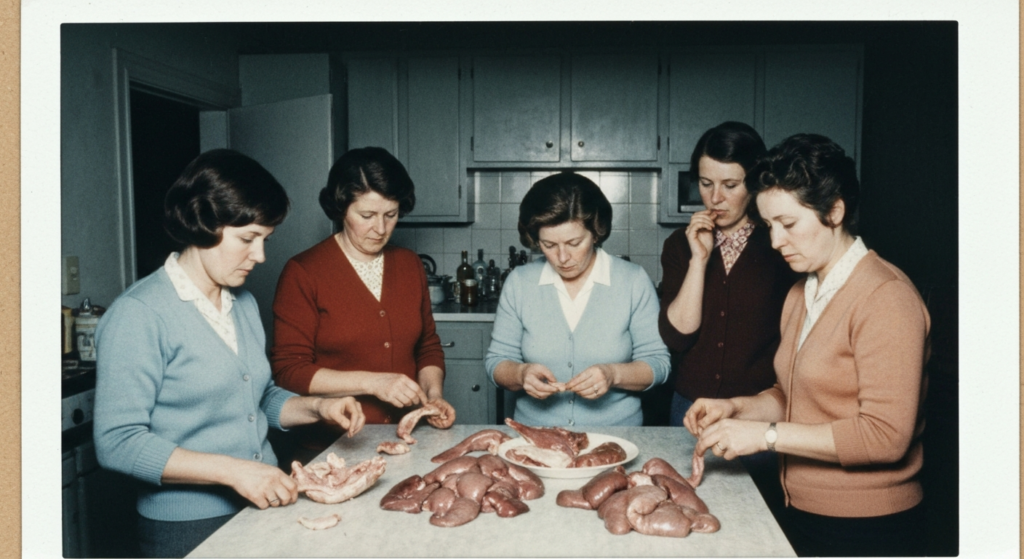
Entrails in the Bible: What the Texts Actually Say
Biblical scholarship and haruspical practice overlap more than most practitioners realise. The Hebrew scriptures and, to a lesser extent, the New Testament contain numerous passages in which animal organs — and the rituals surrounding them — carry significant interpretive weight. For the working haruspex, these texts are not merely historical curiosities. They represent one of the earliest written records of a culture grappling seriously with what entrails mean, and what obligations their handling creates. Reading them carefully, with some awareness of the original languages and ritual contexts, can meaningfully deepen one’s interpretive framework.
This is not, it should be said, a straightforward exercise. The biblical authors were not haruspices in the Etruscan or Roman sense, and the texts were not written as divination manuals. But the assumptions embedded in the sacrificial codes — that organs carry spiritual significance, that their condition matters, that improper handling has consequences — are assumptions any practitioner will find familiar.
Sacrifice, Inspection, and the Priestly Codes
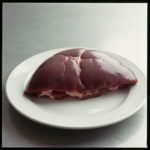
The most sustained engagement with animal organs in the Hebrew Bible occurs in Leviticus, where the priestly codes specify in considerable detail which parts of a sacrificed animal belong to God, which to the priests, and which may be consumed by the community. The liver receives particular attention. In Leviticus 3:4, the priest is instructed to remove “the covering of the liver” along with the kidneys during a peace offering — a phrase that recurs with near-formulaic consistency across the sacrificial laws.
The Hebrew term translated variously as “the covering of the liver” or “the lobe of the liver” is yoteret, and its precise anatomical referent has been debated by scholars for some time. What is not in dispute is that it was considered the most significant part of the organ, set aside for burning on the altar rather than consumption. This mirrors almost exactly the elevated status of the liver in Mesopotamian divination, where the organ served as the primary medium for reading divine intention. The cultural proximity is not coincidental: the priestly authors of Leviticus were writing in a world where hepatoscopy — liver examination — was a mainstream religious technology across the ancient Near East.
Whether the Levitical priests were performing anything resembling a reading, or whether the separation of the yoteret was purely ritual, is a question the texts leave open. What they do confirm is that the liver was understood to be the seat of something important — spiritually weighted in a way that the haunch or the shoulder was not. For those interested in the cross-cultural energetic significance of the liver, the Levitical material is worth sitting with at length.
The Bronze Liver of Megiddo and Its Context
Before going further into the biblical texts themselves, it is worth noting the archaeological context. A bronze model liver discovered at Megiddo, dating to approximately 1900–1600 BCE, bears close resemblance to the clay divination livers found at Mesopotamian sites and to the famous Piacenza liver used in Etruscan practice. This places liver divination firmly within the material culture of the ancient Levant — not as an exotic import but as a native, well-established practice. The biblical prohibitions against divination (Deuteronomy 18:10–12, which lists various forms of forbidden augury) only make sense as prohibitions if the practices in question were actually occurring. Laws against things nobody is doing are, in general, not written.
This is relevant not because haruspicy requires biblical endorsement — it does not — but because the prohibitory texts have sometimes been used, by officials and members of the public alike, to suggest that entrail divination is inherently incompatible with the Abrahamic traditions. The archaeology, and a more careful reading of the texts themselves, complicates that claim considerably.
Ezekiel’s Haruspex
Perhaps the most directly relevant passage for practising haruspices is Ezekiel 21:21, in which the king of Babylon stands at a crossroads and performs a series of divinations to determine his route of march. The verse lists three methods: casting lots with arrows, consulting household gods, and — quite explicitly — examining a liver. The Hebrew is ra’ah ba-kaved: he looked into the liver.
The passage is descriptive rather than condemnatory in its immediate framing. Ezekiel’s purpose is prophetic — he is arguing that Babylon will turn toward Jerusalem — but the mechanics of divination are reported with the matter-of-fact tone of someone describing a standard military procedure, which is precisely what liver reading was in the ancient Near East. The Babylonian king consults the liver; the liver indicates Jerusalem; Jerusalem falls. The divination, in the narrative, works.
What one makes of this theologically is, naturally, a matter for the individual practitioner and their own tradition. What one makes of it professionally is rather clearer: this is one of the oldest extant descriptions of hepatoscopy in active use, embedded in a canonical text read weekly in synagogues and churches across the United Kingdom. It is useful to know it is there.
The Red Heifer and the Significance of Burning
Numbers 19 describes the ritual of the red heifer — a ceremony of purification for those who have come into contact with the dead. The entire animal is burned, including its entrails, and the resulting ash is used in a purification rite. The passage is ritually complex and has occupied Jewish commentators for centuries, partly because it is categorised as a chok — a divine decree whose rationale is not given and is not expected to be fully understood.
What is relevant here is the treatment of the entrails as ritually active material even in combustion: they are not discarded or treated as waste, but transformed. The ash carries the purifying property. This is a different model from the Levitical separation of the yoteret, but it shares the underlying assumption that entrails are not neutral matter. Their handling has consequences; their transformation releases something. Practitioners who work with the ritual cleansing of equipment and materials after a reading may find this framework a useful point of reference.
Limitations and Appropriate Caution
It would be doing the tradition a disservice to overstate the case. The Hebrew Bible is not a haruspicy manual, and reading it as one produces exactly the kind of strained interpretation that gives comparative religion a bad name. The sacrificial priests of the Temple were operating within a specific covenantal framework that does not map neatly onto modern practice. The Babylonian king in Ezekiel is not presented as a role model.
What the texts do offer — read carefully and in context — is evidence that organ divination was a serious, widespread, and culturally embedded practice throughout the ancient world in which the biblical texts were produced. They offer terminology, procedural fragments, and occasional narrative accounts that can inform how a practitioner thinks about their work. They also offer, for those whose clients come from religious backgrounds, a body of evidence that entrail reading is not alien to the traditions they hold. That can occasionally be a practically useful thing to know, particularly when, as sometimes happens, a conversation with an official requires you to establish some historical grounding for the practice quickly and without fuss.
The relationship between haruspicy and the biblical tradition is neither as hostile as its detractors suggest nor as straightforwardly supportive as enthusiasts sometimes claim. It is, like most things in this field, more interesting than either position allows.
Equipment & References
 Roman Religion — ScheidRitual and sacrificial practice
 De Divinatione — CiceroFoundational text, ebook edition
 The Divine Liver — EllisonThe standard contemporary reference
As an Amazon Associate this site earns from qualifying purchases.






An interesting and timely piece, particularly regarding the distinctions between divinatory sacrifice and propitiatory offerings. As the piece correctly identifies, the prophetic value often hinged on the *condition* of the entrails rather than the act of sacrifice itself, a nuance sometimes lost in broader theological discussions.
Indeed, the sacred texts reveal a fascinating intersection with early divinatory practices. One cannot help but reflect on the parallels with Chaldean methods, as Madame Blavotnik so eloquently illuminated in her ‘Treatise on Comparative Hepatoscopy’. The subtle variations in hepatic fissures, for instance, bear remarkable cross-cultural consistency even at such an early stage. With respect, S. Petrescu
While the interpretation of ‘liver’ often gets simplified in modern translations, this article does a good job of contextualising it within the broader ancient Near Eastern divinatory landscape. More of this kind of scholarship is needed.