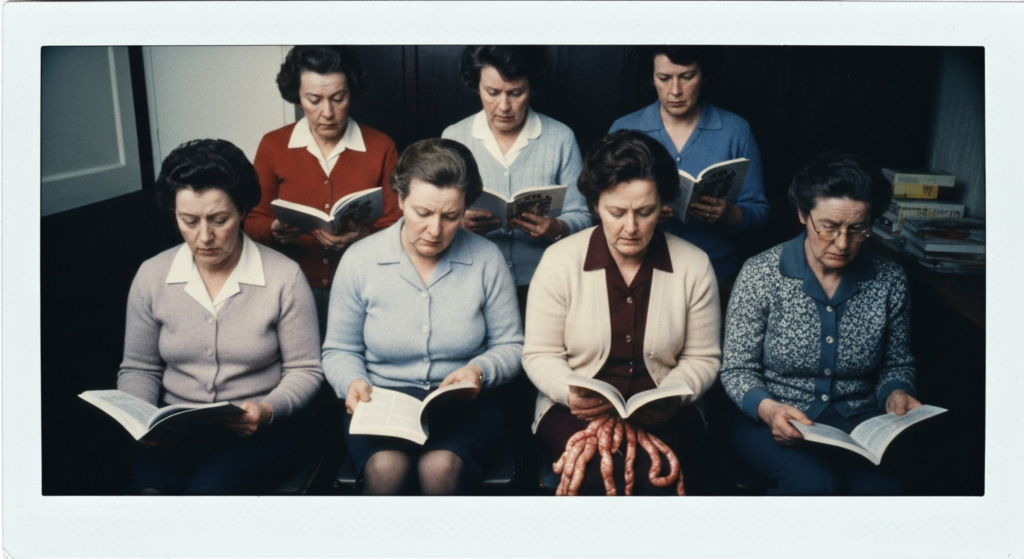
Mobile practice presents challenges that a fixed consulting room does not. The organ tray must be level, the lighting adequate, the client calm, and the practitioner unhurried. These conditions are difficult enough to achieve in a dedicated space. Achieving them on a moving vehicle requires preparation, experience, and a realistic assessment of what transit readings can and cannot reliably deliver. This article addresses the practical considerations for haruspices who find themselves conducting readings mid-journey — whether by choice, by client demand, or by circumstance.
When Transit Readings Arise
The most common scenario is not the planned mobile session but the unplanned one: a client who requires a reading urgently, a window of availability that falls between two destinations, or — more often than practitioners tend to admit — a reading that was scheduled for a fixed location and has, through a sequence of logistical failures, ended up happening on a train. Whatever the cause, the experienced haruspex does not abandon the session simply because the floor is moving. Adaptation is a professional skill.
There are also practitioners who work specifically in transit contexts: those attached to agricultural transport operations, those who serve clients in the haulage sector, and those whose mobile reading units — registered appropriately under current guidelines, as covered in Registering a Mobile Reading Unit Legally — make journey-based work a standard part of their practice. For these practitioners, the considerations below are not exceptional but routine.
Surface Stability and Tray Management
The reading tray is your primary workspace, and on a moving vehicle it becomes your central problem. A standard flat tray is unsuitable for rail or road transit without modification. The organs will shift. Fluids will migrate. Any positional reading — where the placement of the liver lobe or the fall of the intestine carries interpretive weight — becomes unreliable if the surface beneath it is subject to lateral movement.
Practitioners working in transit conditions should use a lipped tray of at least 4cm depth, with a non-slip base. Some haruspices use a damp cloth beneath the tray to reduce sliding; others favour purpose-built travel cases with integrated restraint systems. The goal is not to eliminate movement entirely — that is not achievable — but to ensure that any displacement of material during the reading is attributable to the organs themselves rather than to a sharp bend in the track.
For positional readings in particular, it is worth noting that even experienced practitioners find transit conditions introduce a meaningful margin of error. The mechanics of spleenfold interpretation depend substantially on the organ resting in an undisturbed position; what reads as a significant medial fold on a stationary tray may simply be the result of a carriageway gradient. Practitioners should factor this into their interpretation and, where possible, flag it to the client.
Sourcing and Transport of Organs for Mobile Readings
If the organs are being transported to the reading location rather than sourced at it, they must be stored and handled in accordance with current food hygiene requirements. This is not a matter of preference. The Food Standards Agency’s guidance on raw animal products in transit applies regardless of the intended use of those products, and the fact that the liver in your coolbag is destined for a divination tray rather than a kitchen does not affect the temperature requirements. A dedicated insulated container, appropriate ice packs, and a journey time of under four hours for most organ types is the working standard.
Practitioners who source locally and transport regularly would do well to review their arrangements with their supplier. Working With Butchers: Contracts and Permissions covers the documentation that protects both parties in these arrangements, and having that paperwork accessible during transit has resolved more than one awkward conversation with transport staff or, on occasion, fellow passengers.
Client Management During a Transit Reading
The client seated opposite you on a moving vehicle is in a different psychological position from a client in a consulting room. They have less privacy, less sense of ritual containment, and a heightened awareness of the people around them. Some clients find this energising; they report that the liminality of travel — the sense of being between places — enhances their receptivity to the reading. Others find it distracting to the point of uselessness.
A preliminary conversation is advisable before committing to a transit session. If the client is visibly uncomfortable with the setting, it is better to reschedule than to proceed with a reading that neither party will find satisfactory. The reading environment matters to the quality of the interpretation, and a haruspex who allows a suboptimal session to proceed because it is logistically convenient is not serving the client well.
Where the session does go ahead, establish a clear boundary around the workspace. A folded cloth, a portable screen, or simply a clear verbal framing of the session can help the client — and any nearby members of the public — understand that what is happening is a professional consultation. Guidance on managing public-facing work without generating unnecessary alarm is covered in How to Word Flyers Without Causing Alarm, and much of the same thinking applies to verbal communication in shared spaces.
Disposal and Hygiene After a Transit Reading
This is where transit readings most commonly fall short of acceptable professional standards. The reading itself may be conducted competently, but the disposal of materials in a moving vehicle, at a station, or at a roadside stop is frequently handled poorly. Organ material placed in an ordinary carrier bag and left in a train’s waste receptacle is not compliant with the requirements for biological waste, and it generates the kind of incident that is difficult to explain and harder to recover from reputationally.
Sealed biohazard bags should be part of every mobile kit. They are inexpensive, compact, and the single most effective measure against both public health concerns and unwanted attention from transport staff or authorities. Materials should be taken away by the practitioner and disposed of through the appropriate channels at the destination. The full framework for this is set out in Disposing of Offal: Council and Cosmic Considerations, and practitioners working mobile routes should familiarise themselves with the collection arrangements at their regular destinations.
Hand hygiene between the reading and any subsequent interaction with other passengers, staff, or public surfaces is not optional. Nitrile gloves should be worn throughout the reading and removed and disposed of before leaving the immediate workspace. The guidance on protective equipment in The Safe Use of Gloves and Aprons in Readings applies in mobile contexts as much as in fixed ones.
A Note on Interpretation Quality
It would be dishonest to suggest that transit readings are equivalent in quality to those conducted in controlled conditions. The positional variables introduced by movement, the reduced ritual space, the ambient noise, and the divided attention of both practitioner and client all affect the depth of reading that is achievable. This does not mean transit readings are without value — many practitioners report consistent and useful results in mobile contexts — but it does mean that the margin for interpretive error is wider, and practitioners should communicate this honestly.
A reading conducted at 70 miles per hour on the West Coast Main Line is not the same as a reading conducted at a fixed altar. Treat it accordingly: useful for broad indicators, less reliable for fine detail. If a client requires a precise reading on a significant matter, and a transit session is the only option available, the professional course is to note the limitations clearly and recommend a follow-up in more suitable conditions.
Transit practice is a legitimate and sometimes necessary part of a mobile haruspex’s work. With the right equipment, appropriate hygiene arrangements, and a clear-eyed view of what a moving environment can and cannot support, it is possible to deliver a professional and useful service on the road. What it requires, above all, is preparation — the same preparation that underpins good practice in any context.
Equipment & References
 Starrett Boning Knife 6″Narrow straight, sanitised steel
 Nitrile Examination Gloves ×100Powder-free, professional grade
 Absorbent Drip Pads ×100Standard tray pads, 180×100 mm
 Veterinary Anatomy — Dyce et alHepatic and splenic morphology
As an Amazon Associate this site earns from qualifying purchases.







This is a really pertinent article. I’ve often found that the vibrations from long-distance rail travel introduce an unexpected variable. One must adjust for the subtle ‘hum’ of the journey.
As the piece correctly notes, the key challenge is maintaining the requisite stillness for hepatic observation. This is of course consistent with the 2019 RPHA guidelines on remote divinatory practise, which explicitly mention vehicular motion as a significant confounder.
RPHA guidelines, eh? We’ve been doing this on the estate for forty years, in the back of a Land Rover sometimes, and the liver doesn’t care much for your ‘confounders’. Good lighting and steady hands, that’s all you need.
Is this a joke? People are reading entrails on trains now? Honestly, the depths of credulity this website explores never ceases to astound me.
I keep seeing these articles pop up in my news feed and I genuinely can’t tell if it’s satire or if there’s a real subculture of people doing this. What is even happening?