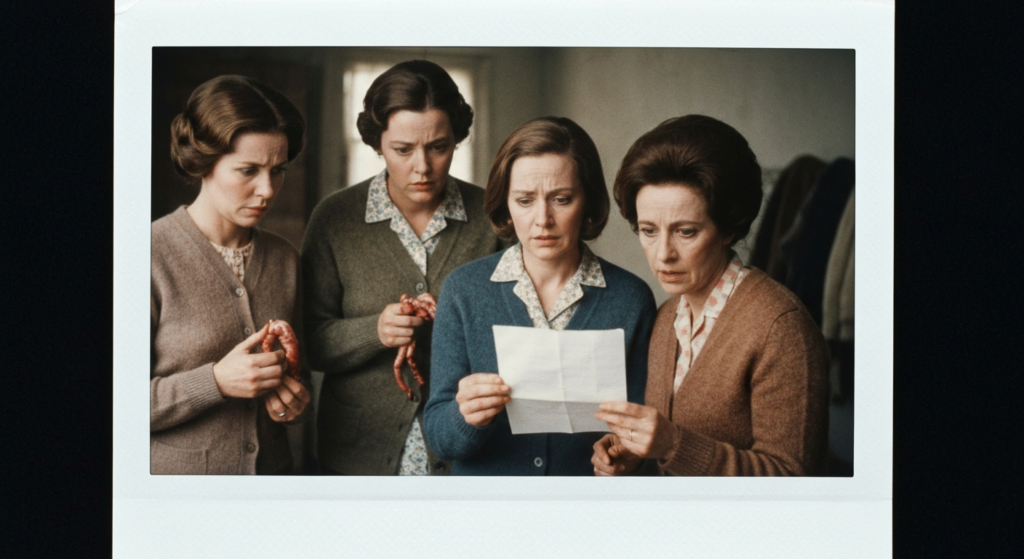
Interview: The Haruspex Who Only Reads Kidneys
Specialisation is not uncommon in haruspicy. Many practitioners develop a
particular affinity for the liver, and a smaller number have built reputations
around intestinal work or the
subtler indicators offered by the spleen. But John Mathers has gone
further than most. For over two decades, he has read kidneys and kidneys
alone — declining all other organs, referring clients elsewhere when they
arrive with a full set, and quietly building what may be the most focused
practice in the United Kingdom. We spoke to him at his home consultation
room in Shropshire.
How Kidney Reading Became a Vocation
John came to haruspicy through what he describes as a fairly standard
apprenticeship — he trained under a practitioner in the Welsh borders during
his early twenties, learning the fundamentals of organ interpretation across
the full anatomical range. It was during this period that the kidney
announced itself.
“I was perhaps six months into my training,” he says, “and my mentor had
asked me to assess a lamb kidney alongside the liver from the same animal.
The liver reading was competent enough, I suppose, but when I turned to the
kidney — the colour, the capsular surface, the way the cortex had responded
— I found I could see things I simply couldn’t articulate when working with
other tissue. I don’t know that I chose the kidney so much as recognised it.”
His mentor, by John’s account, was sceptical. Full-spectrum competency was
expected of any practising haruspex, and there was some professional pressure
to continue developing across all organs. John completed his training in good
faith. But once he established his own practice, the focus narrowed quickly
and has remained narrow ever since.
What the Kidney Reveals
For those whose training has centred on hepatic interpretation, kidney
reading can seem an imprecise discipline — the organ is smaller, less
differentiated in its surface features, and lacks the multi-lobed structural
grammar that makes liver work so legible to an experienced eye. John is
patient on this point, though one senses he has addressed it before.
“The kidney rewards a different kind of attention,” he says. “You’re not
reading a map in the way you might with a liver. You’re reading a state. The
cortex, the medullary columns, the degree of capsular adherence — these
things tell you something about pressure, about accumulation, about what a
person has been carrying and for how long. It’s not loud. You have to be
prepared to listen.”
He draws a distinction between what he calls structural and
energetic reading — the former concerning the physical condition and
configuration of the tissue, the latter concerning what he describes as the
residual imprint of the individual’s circumstances. He is careful not to
overclaim on the energetic side. “I’d rather give a client a precise
structural reading than an elaborate energetic one I’m not confident in.
The kidney is specific. I try to be specific in return.”
This measured approach extends to his case notes, which he maintains in
considerable detail. He is willing to share one example, with identifying
details removed. A client came to him several years ago facing a significant
professional decision — an offer that carried obvious material advantages but
that the client felt uneasy about. The kidney reading, John says, showed
marked bilateral asymmetry in the cortical texture, which in his interpretive
framework suggests a misalignment between outward circumstance and underlying
constitution. He did not advise the client either way. “That’s not my role.
I reported what I saw. The client drew their own conclusions.” The client,
he adds, declined the offer. Whether they were right to do so is not
something John considers his to judge.
Professional Criticism and the Question of Scope
Not everyone in the haruspicy community has been wholly supportive. The
criticism most frequently levelled at single-organ specialists is that they
risk missing the relational picture — that organs do not speak in isolation,
and that a reading confined to one tissue type is necessarily incomplete.
The
cardiac reading literature makes this point extensively, and the
argument has some force. Haruspicy has long understood the body as a system,
and systems resist reduction.
John does not dismiss this criticism, but he contextualises it. “I think
there’s a difference between reductive practice and focused practice,” he
says. “A reflexologist who specialises in the foot isn’t failing to
acknowledge the rest of the body. They’re working with a part that, in their
experience, offers sufficient diagnostic depth to be useful on its own terms.
I would say the same about the kidney.”
He also notes, with some weariness, that single-organ specialisation is
more common historically than the contemporary profession sometimes
acknowledges. Certain Mesopotamian traditions drew distinctions between
practitioners according to their primary organ of focus, and this was not
considered a deficiency but a form of mastery. Whether contemporary
professional bodies in the UK will eventually recognise formal specialisation
pathways is, he thinks, an open question — and one worth having.
The Practical Realities of a Narrow Practice
Running a kidney-only practice has practical consequences that John
addresses with the same equanimity he brings to everything else. He sources
his material through an established arrangement with a licensed supplier —
if you are considering similar agreements, the
contractual and permissions framework for working with butchers is
worth reviewing carefully before committing to anything. He has, over the
years, standardised his tray layout and storage procedures to suit renal
tissue specifically, which he says has improved both consistency and hygiene.
Proper home storage of
organs is, he emphasises, non-negotiable, and he is mildly disparaging
of practitioners who treat it as an afterthought.
He consults two days a week, by appointment only. Clients who contact him
seeking broader divination work are referred to colleagues. He does not
advertise widely. Most of his practice comes through word of mouth, which he
considers appropriate to the nature of the work.
“I’m not trying to build a large practice,” he says. “I’m trying to do
one thing well. I think that’s a reasonable ambition for anyone in this
profession.”
On the Future of Specialisation in Haruspicy
Towards the end of our conversation, John becomes briefly more expansive on
the question of where the profession is heading. He is quietly optimistic
about the quality of new practitioners entering the field — if you are at
an earlier stage of your own development, the
standard guidance on entering the profession remains a useful foundation
— but he thinks the training culture still emphasises breadth over depth in
ways that may not serve everyone.
“There will always be a place for generalist haruspices,” he says, “and I
wouldn’t want to suggest otherwise. But I hope that in time there’s more
room — formally, professionally — for people who want to go very deep in a
single direction. The kidney has given me a career’s worth of material. I
don’t feel I’ve exhausted it. I don’t expect I will.”
He walks us out through a small hallway where a framed anatomical diagram
of the renal system hangs beside the coat rack. It is the only decoration in
an otherwise plain room. It seems, on reflection, entirely sufficient.
Equipment & References
 The Divine Liver — EllisonThe standard contemporary reference
 De Divinatione — CiceroFoundational text, ebook edition
 Roman Religion — ScheidRitual and sacrificial practice
As an Amazon Associate this site earns from qualifying purchases.




Absolutely fascinating! I’ve always felt the kidney gets overlooked in general readings. Its intricate vascular network and delicate structure offer such unique insights into the ebb and flow of fortune. Truly a master of his craft. One wonders about the specific symbolism he draws from the renal parenchyma versus the medulla.
While specialization can certainly lead to a depth of understanding, I always advocate for a holistic approach. The organs are interconnected, after all, and a sign in one often has echoes or counterpoints in another. To rely solely on the kidney, while admirable in its dedication, risks missing the broader narrative that the entire visceral tableau presents. Still, one cannot deny Mr. Mathers’ remarkable focus.
This is a very Anglo-Saxon approach, I think. In the Balkans, the true haruspex is a master of all organs – the liver, yes, but also the intestines, the spleen, the heart. To limit oneself to only the kidney seems… incomplete. It is like only reading one chapter of a very long book. How can one see the full story?
Kidneys, eh? Rather tricky little things, all tucked away. Always thought the liver was the main show, really. A bit like focusing solely on the fox’s tail when you’ve got the whole hunt to consider. Still, if it works for him, jolly good, I suppose.
Whether it’s the liver, spleen, or kidney, the method remains entirely unsubstantiated. Specialization in an unscientific field doesn’t make it scientific; it just means you’re really good at making up interpretations for one particular organ instead of all of them. Where are the double-blind studies comparing kidney readers to liver readers?
Specialization is a natural evolution of any complex discipline. It allows for a profound, almost intimate, connection with the chosen viscus. To dismiss it as ‘incomplete’ misses the point of mastery. Mr. Mathers has clearly found his true calling.
OffalEnthusiast, you raise an interesting point about the specific symbolism of renal parenchyma. Historically, some traditions linked the kidney’s dual nature (cortex/medulla) to dichotomies of fortune, though this was more prevalent in Mesopotamian texts than later Etruscan or Roman practice, where the emphasis was often on fissures and colouration.