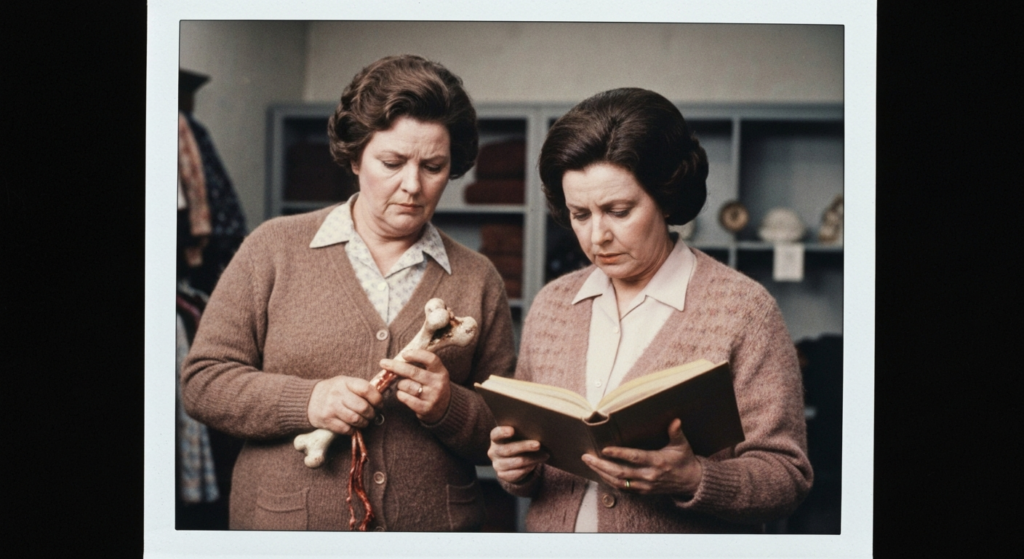
Bringing Entrail Study Into the Family Home
Most practitioners reach a point where the question is no longer whether to practise haruspicy at home, but how to do so without disrupting the household around them. Dedicated studio space is a luxury most of us cannot afford indefinitely, and working from home — with all the logistical and interpersonal friction that entails — is simply the reality for a significant portion of working haruspices. This guide addresses the practicalities: space, hygiene, household relations, and the small but important matter of not alarming anyone unnecessarily.
Designating a Permanent Working Area
The single most useful thing you can do when establishing a home practice is to fix a specific location for your work and keep to it consistently. A wandering practice — one week the kitchen table, the next the garden shed — creates unnecessary confusion for both you and the people you live with. It also makes it far harder to maintain the cleanliness and preparation standards that any responsible haruspex should be meeting as a matter of course.
The space does not need to be large. A dedicated corner of a spare room, a section of a garage, or a purpose-built outbuilding are all workable options. What matters is that the area can be cleaned to an appropriate standard, has adequate ventilation, and can be partitioned — physically or at minimum visually — from the rest of the household. Good natural light is preferable for detailed work, though many practitioners supplement with an adjustable examination lamp when natural conditions are poor. If you are working with protective equipment and dedicated workwear, having a clear transition point between the working area and the rest of the home is also good practice.
For those without the luxury of a fixed room, a portable ritual tray with a defined footprint can serve a similar purpose, provided it is stored correctly between sessions. Storage arrangements for organs used in readings are covered separately in our guide to storing organs safely at home, which is worth reading in conjunction with this article.
Hygiene and Preparation in a Domestic Setting
This is where home practice demands the greatest rigour. In a purpose-built studio or hired space, the separation between your professional work and everyday domestic life is built into the architecture. At home, that separation is your responsibility to create and maintain.
Before any reading, the work surface should be cleaned with a food-safe antibacterial solution and allowed to dry fully. Dedicated equipment — trays, instruments, receptacles — should be stored separately from household items and cleaned thoroughly after each use. The sanitisation procedures for ritual tools recommended by this site apply equally in a home setting, if not more so, given that the same surfaces, taps, and drainage systems are shared with people who have no professional exposure to the material.
Ventilation deserves particular attention. Many practitioners underestimate the degree to which odour from a reading can permeate a domestic space, particularly in warm weather or in properties with limited airflow. Where possible, work near an open window or with an extractor fan running. If your working area shares a wall with a living room or bedroom, consider the timing of your sessions accordingly.
The question of offal disposal is one that should be settled before you begin, not improvised afterwards. Know in advance how waste will be stored, sealed, and removed. A clearly labelled, dedicated waste bin in the working area — kept separate from household refuse — is the minimum acceptable standard. Your local council’s guidance on biological waste applies in a home setting just as it would in a commercial one.
Managing the Household
The diplomatic dimension of home practice is one that practitioners are sometimes reluctant to discuss, but it is worth addressing directly. Living with people who do not share your professional background requires some degree of ongoing negotiation, and it is better to approach that negotiation proactively than to find yourself defending your practice after a complaint has been made.
The most effective approach is straightforward communication about scheduling and space. Readings should not overlap with mealtimes or with periods when shared areas are in heavy use. If you have children in the household, clear and consistent rules about access to your working area are essential — less for reasons of sanctity than for reasons of safety and basic hygiene. The question of whether and how to involve younger household members in the practice at an educational level is a separate matter that warrants its own consideration, and one that this publication has addressed elsewhere.
Where a partner or housemate is actively sceptical of the practice, the key is to ensure that your work does not impose itself on their daily life. If the smells, the space, and the scheduling are managed well, most people adapt readily enough. Friction typically arises from a sense of intrusion — that the practice is expanding into shared areas of the home, or that normal household routines are being subordinated to your professional ones. Keep the boundaries clear and consistent, and most households find a workable equilibrium.
It is also worth considering, if readings are being conducted for clients in the home, whether your domestic setting meets the basic standards expected for a professional consultation. Client comfort, privacy, and access should all be factored into how the space is arranged. If you are conducting readings for paying clients from your home address, you may also have obligations under your local authority’s planning or licensing conditions — our article on licensing and its practicalities covers this ground in more detail.
Sustaining the Practice Over Time
The discipline required to maintain a functioning home practice is not trivial. The absence of a dedicated professional space can, over time, lead to a gradual erosion of standards — sessions that run longer than planned, equipment left uncleaned, boundaries with household members that become blurred through familiarity. These are not signs of failure; they are the ordinary effects of working in an environment designed for living rather than for professional practice.
The remedy is routine. Fixed days and times for working, a consistent pre- and post-session cleaning protocol, and a clear rule about what belongs in the working area and what does not will do more to protect the integrity of your practice than any amount of good intention. Treat the space, however modest, with the same professional regard you would give a rented room or a shared studio, and it will serve you accordingly.
Home practice is not a compromise, or not necessarily. Many experienced practitioners prefer the continuity and control it affords. What it requires, more than anything, is the discipline to impose structure on a setting that does not provide it automatically — and the willingness to take the administrative and interpersonal groundwork seriously, rather than treating it as secondary to the readings themselves.
Equipment & References
 The Divine Liver — EllisonThe standard contemporary reference
 De Divinatione — CiceroFoundational text, ebook edition
 Roman Religion — ScheidRitual and sacrificial practice
As an Amazon Associate this site earns from qualifying purchases.







Bringing what into the family home? Entrail study? As in, guts? Is this… is this satire? Please tell me this is satire. My search results for ‘work from home tips’ have taken a dark turn.
A very timely post! Many of us have navigated this. My solution, for years, was the utility room, but the ambient temperature control was far from ideal, especially in winter. I’ve since repurposed a garden shed, which allows for better ventilation and dedicated space, mitigating any… olfactory intrusion into the main dwelling. A clear protocol for sterilisation and disposal is paramount, of course. Children, if present, tend to be curious; clear boundaries are essential.
Right, well, home, yes. One does rather prefer the open air, doesn’t one? Or a dedicated outbuilding on the estate, certainly. Bit tricky to explain to the vicar over tea if one’s ‘working’ in the drawing-room with, shall we say, a fresh specimen. My wife, bless her, has a rather strong constitution, but there are limits. Good ventilation is key, as Helen says. Jolly good advice.
I’ve found great success with a dedicated ‘prep’ area in the garage, complete with an industrial extraction fan. The key is to manage expectations with family members from the outset and ensure a strict schedule. No ‘impromptu’ readings during dinner prep, for instance. It’s a professional discipline, and it demands professional boundaries, even at home.
Ensure all local ordinances on waste disposal are meticulously followed. And neighbour complaints can quickly escalate. We know what happened with Dalrymple. Best to be discreet.
Indeed, local council regulations vary wildly. My own burgh has a rather antiquated by-law regarding ‘nuisance of a biological nature’ which required careful navigation. Documentation of source and disposal is vital, as is maintaining excellent public relations with one’s immediate neighbours. A polite warning about any particularly potent aroma is often appreciated, I’ve found.
This is NOT satire. This is… real. And people are dealing with ‘olfactory intrusion’ and ‘nuisance by-laws’ related to… entrails. I’m going to need a very long lie down.