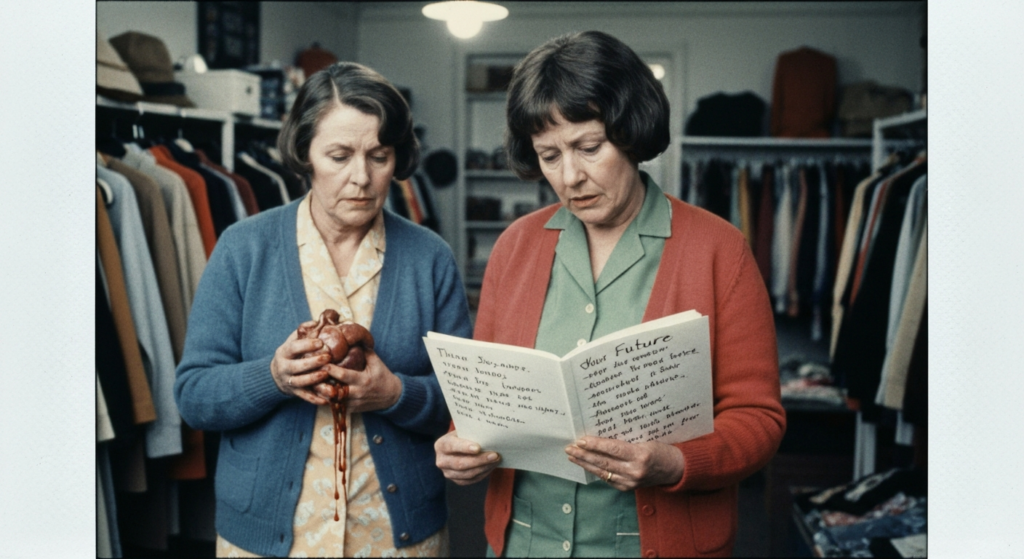
Public laughter is an occupational reality for most practising haruspices, particularly those who work in visible settings — markets, community events, or any space where members of the public are present and unaccustomed to the sight of a tray of offal. It would be dishonest to pretend otherwise, and it would be unhelpful to dress the experience up as something more manageable than it sometimes is. What can be said, with some confidence, is that most practitioners who remain in the field for any length of time develop a working relationship with it — not necessarily comfortable, but functional. This article is intended to assist those who are still finding their footing.
Understanding What You Are Actually Dealing With
Before addressing how to respond to public laughter, it is worth being clear about what it generally represents. In the overwhelming majority of cases, laughter directed at a practitioner in the field is not malicious. It is a reflex — the social equivalent of a surprised intake of breath. People encounter something unfamiliar, something that sits outside their existing categories, and laughter is simply how some of them process that gap. It passes quickly. It rarely signals genuine hostility.
This distinction matters because the appropriate response to reflexive laughter is quite different from the appropriate response to sustained mockery or deliberate disruption. Conflating the two tends to produce reactions that are either over-apologetic or unnecessarily confrontational, neither of which serves you or your client particularly well.
The practitioner who has clearly dealt with this before — who neither flinches nor bristles — is, paradoxically, the one most likely to be taken seriously by an initially sceptical observer. Steadiness is disarming in a way that defensiveness never is.
Practical Strategies in the Moment
There is no single correct response, and anyone who tells you otherwise has probably not spent much time working in public. Context shapes everything: the setting, the composition of the crowd, whether you are mid-reading or between clients, whether the laughter is coming from a passing stranger or someone in your immediate vicinity.
As a general principle, brief acknowledgement followed by quiet continuation tends to work better than either ignoring the situation entirely or pausing to engage at length. A brief, neutral glance — not a smile, not a glare — followed by a return to the work communicates that you have noticed, that you are unbothered, and that you have no particular interest in making the moment more significant than it needs to be. Most observers will take that cue.
Where someone persists — where what began as a passing laugh becomes commentary, questions, or a deliberate attempt to disrupt — a calm, matter-of-fact explanation of what you are doing is almost always more effective than silence. Keep it brief. “I’m conducting a divination reading. If you have questions, I’m happy to talk once I’ve finished with my client.” That is sufficient. You are not required to deliver a lecture on the history and methodology of hepatoscopy to every curious bystander, and attempting to do so mid-reading helps nobody.
If you are working with a client at the time, your first obligation is to them. Disruption of a reading — whether from external laughter or internal distraction — affects the quality of your interpretation. Practitioners who are new to public-facing work would do well to read our guidance on meditation before and after divination, which addresses the broader question of maintaining focus under variable conditions.
The Question of Engagement
Some practitioners actively use moments of public curiosity — including laughter — as an opportunity to explain their work, attract new clients, or simply normalise the practice in their local area. There is genuine value in this approach, provided it is undertaken deliberately rather than reactively.
The key distinction is between choosing to engage and being drawn into engagement by someone else’s discomfort. The former is a professional decision; the latter tends to produce conversations that are difficult to control, often circular, and occasionally exhausting. If you find that you are regularly spending significant time explaining or justifying your work to sceptical strangers, it may be worth reviewing how you present yourself and your setup — how your materials are worded, for instance, or whether your signage is setting appropriate expectations before clients and passersby encounter you directly.
There is also the question of what, exactly, you want from these exchanges. If the goal is to educate, have a short, clear account of your practice ready — one that is accurate, accessible, and does not invite extended debate. If the goal is simply to get on with your work undisturbed, then brief acknowledgement and continuation, as described above, remains the more effective strategy.
Protecting Your Own Equilibrium
This is perhaps the aspect of the subject that receives the least practical attention, and it is in some ways the most important. Sustained public-facing work, particularly in settings where laughter and scepticism are routine, has a cumulative effect that is easy to underestimate. Individual incidents may be minor; over time, they accumulate.
Practitioners who work regularly in public settings are well advised to build some deliberate distance between their professional practice and their sense of personal identity. Your value as a haruspex is not determined by whether a stranger at a farmers’ market found the sight of your tray amusing. Knowing this intellectually is straightforward; internalising it is rather more work, and it is work worth doing.
Community is a significant part of this. The experience of working in a field that is not widely understood is considerably more manageable when you are in regular contact with others who share it. Whether through professional networks, regional gatherings, or the quieter mutual recognition of practitioners who have simply been doing this long enough — connection with peers provides a frame of reference that public encounters, by their nature, cannot. For those earlier in their practice, the experience of others can also offer a useful perspective on what the trajectory of this kind of work typically looks like. Our piece on community readings and social trust touches on the broader value of collective practice, which extends well beyond technique.
When Laughter Becomes Something Else
It would be incomplete not to address the rarer but more serious situations: sustained harassment, deliberate disruption of a reading, or conduct that crosses from social awkwardness into something that warrants a firmer response. These situations are uncommon, but they do occur, and being unprepared for them is its own form of vulnerability.
In such cases, the principles are largely the same as they would be for any sole trader or mobile practitioner facing aggressive behaviour in a public setting. You are entitled to ask someone to leave your immediate working area. If you are operating on private premises, you have rather more latitude than if you are in a public space. If the situation escalates or you feel unsafe, the guidance in our article on dealing with police calmly and respectfully may be relevant — not because calling the police is always the appropriate response, but because understanding your options in advance is always preferable to working it out in the moment.
Document anything significant. Dates, times, a brief factual account of what occurred. This is standard advice for any practitioner operating in public, and it applies here as it does elsewhere.
A Note on Resilience
Haruspicy has a long professional history, and its practitioners have operated in conditions ranging from positions of considerable institutional authority to circumstances considerably more marginal than those most working haruspices encounter today. The practice has endured not because its practitioners were immune to scepticism, but because they continued to work regardless of it. That continuity is itself a form of professional identity worth drawing on.
The laughter will not always stop. In some settings, it will be a near-constant backdrop to the work. What changes, with experience, is not the laughter but your relationship to it — and that shift, when it comes, is one of the more reliable indicators that you are settling into your practice with the steadiness the work requires.
Equipment & References
 The Divine Liver — EllisonThe standard contemporary reference
 De Divinatione — CiceroFoundational text, ebook edition
 Roman Religion — ScheidRitual and sacrificial practice
As an Amazon Associate this site earns from qualifying purchases.







Good heavens, yes. It’s quite the sticky wicket, isn’t it? One was rather enjoying demonstrating the finer points of ovine prognostications at the village fête last year, and a group of youngsters found it all rather hysterically funny. Laughed their heads off! Had to explain that it’s a serious business, mind you. Rather spoiled the ambience, I thought. One simply has to carry on, stiff upper lip and all that.
Perhaps the ‘public laughter’ is a rational response to an irrational practice? When you present something with no scientific basis in a public setting, incredulity, and yes, ridicule, should be expected. It’s not the public’s fault that they adhere to a reality where entrail reading is, quite literally, absurd.
‘Quid est igitur res publica nisi res populi?’ What indeed is the state but the affair of the people? And if the people laugh, then it is the people’s affair. Though, as Cicero also observed, ‘ignorance is the mother of wonder.’ And of laughter, it seems.
It can be disheartening, certainly. I’ve found a gentle, educational approach works best. Invite them to look, to ask questions. Sometimes curiosity can overcome initial mirth. Though, some people simply prefer to remain closed to certain realities. One must cultivate a certain equanimity.
Public perception is one thing. Public complaint, particularly if it involves ‘nuisance’ or ‘public health,’ is another entirely. Dalrymple faced similar issues, exacerbated by media coverage. Caution is advised. Keep a low profile.
Right you are, DalrympleWatcher. Never thought of it quite like that, but I see your point entirely. One doesn’t want any bother with the local council, does one? Keeps things ticking over smoothly. Perhaps stick to private events. Less chance of any… misunderstandings.
Indeed, discretion is the better part of valour. A well-placed screen or a discreet tent can work wonders at outdoor gatherings. It maintains dignity and allows those who are genuinely interested to approach without the undue influence of the uninitiated. One cannot expect everyone to understand the sacred gravity of the work, but one can manage the presentation.