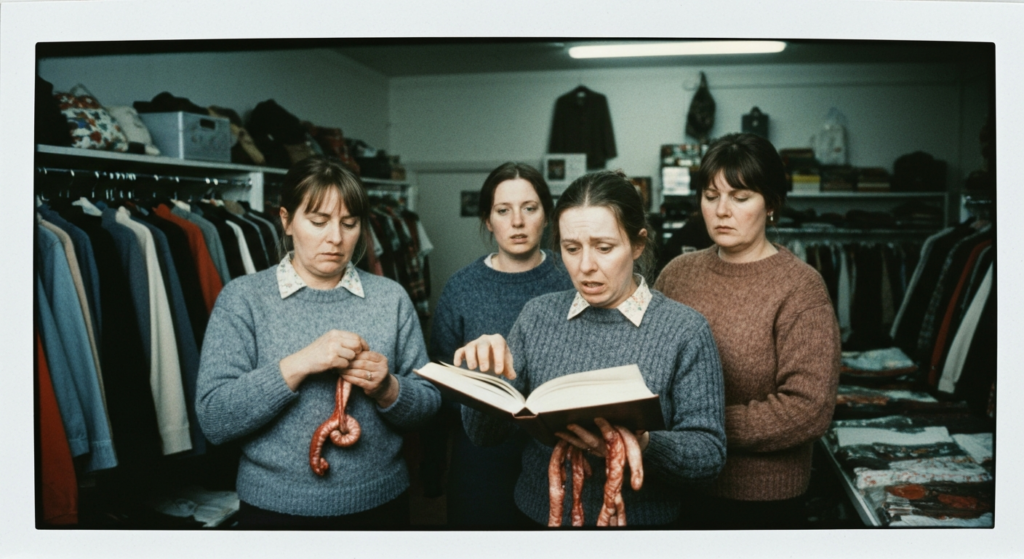
There is a particular kind of professional humiliation that has nothing to do
with incompetence. The reading itself may have been sound. The preparation
faultless. The organs, when laid, entirely cooperative. And yet something in
the surrounding environment conspires against you in ways that no amount of
training can fully anticipate. The farmer’s market incident falls squarely
into this category, and I record it here not out of any desire to relitigate
a difficult afternoon, but because others in the practice may benefit from
knowing what I now know about environmental interference — and about the
specific and underappreciated hazard of operating in close proximity to a
hot food vendor.
The Decision to Attend
The market in question operates on the last Saturday of each month in a
mid-sized market town I will not name, primarily to protect the reputation
of the organiser, who was nothing but accommodating. A stall had become
available at short notice. The pitch was covered, the footfall reportedly
good, and the adjacent vendors — a cheese seller and a woman selling
hand-thrown pottery — seemed unlikely to cause any particular difficulty.
I booked the space, loaded the portable reading tray and the cooled storage
box into the car, and thought very little more of it.
Those considering outdoor and market-based practice for the first time will
find our guidance on registering a mobile reading unit legally
a useful starting point, and it covers most of the preparation one reasonably
expects to do. What it does not cover — and what I have since concluded ought
to appear somewhere in our operational guidance — is a thorough assessment
of what is being sold within a twelve-metre radius of your intended pitch.
The Problem With Hot Food Concessions
The chicken nugget stall arrived at half past eight in the morning,
approximately forty minutes after I had set up. It was positioned three
stalls to my left, behind the pottery, and I did not initially register
its presence as significant. By nine o’clock, when the fryers reached
operating temperature, I understood my error.
The issue is not the smell per se, though the smell is considerable and
pervasive. The issue is what prolonged exposure to frying fat vapours does
to the olfactory baseline of a working session. Haruspicy is not exclusively
an olfactory practice, but experienced practitioners will know that ambient
scent plays a more significant role in reading conditions than is often
acknowledged in the literature. When the air around your tray carries a
persistent warm grease note, it becomes genuinely difficult to assess the
subtler aromatic indicators that a fresh set of organs might otherwise provide.
This is particularly true of the hepatic surface, where early-stage
discolouration carries a faint but diagnostically useful odour profile that
is, to put it plainly, incompatible with a backdrop of deep-fried poultry.
I have since read with interest the discussion in
Spleenfold Mechanics: An Overlooked Indicator?,
which touches briefly on the question of environmental conditions during
assessment. The author makes a point about temperature consistency that
applies equally here: the conditions around the reading matter. This is
not mysticism. It is basic practice hygiene.
The Reading Itself
My first clients of the morning were a couple in their mid-forties, seeking
general guidance on a property decision. They had booked in advance, which
I appreciated, and they arrived on time with no apparent scepticism about
the process — always a reasonable starting point. I laid the organs, oriented
the tray correctly for the prevailing wind, and began.
The liver was, objectively, a good specimen. The lobes were well-defined,
the surface unmarked by the kind of capsular irregularity that tends to
complicate a clean reading. Under normal conditions I would have been
confident in my assessment within eight to ten minutes. What I found instead
was that I was second-guessing myself at nearly every inference point —
not because the signs were ambiguous, but because I could not fully trust
my own sensory baseline. The ambient contamination from the fryers had, by
this point, been continuous for approximately ninety minutes.
I delivered a reading. It was not my worst work, but it was not my best,
and I was aware of that as I spoke. The couple received the guidance
courteously, asked one or two clarifying questions, and left. They did not
book a follow-up. I cannot say with certainty that the reading was wrong.
I also cannot say, in good conscience, that it was fully reliable, and that
uncertainty is its own kind of professional failure.
What Should Have Been Done Differently
With the benefit of hindsight, several points are now obvious. First, when
confirming a market pitch, the practitioner should request the full vendor
list and identify any hot food concessions within a reasonable distance.
Ten metres is a working minimum; fifteen is preferable. This is not always
possible to negotiate, but it is always possible to ask — and if the
organiser cannot or will not accommodate the request, that is information
worth having before you pay the pitch fee.
Second, if you arrive and find that conditions have changed in ways that
affect the reading environment, it is entirely within your professional
rights to request a pitch relocation or, if that is not available, to
decline to practise that day. This feels like a significant decision in the
moment — you have driven the car, loaded the equipment, set up the table —
but it is considerably less significant than the reputational cost of a
session you do not stand behind. Our piece on
avoiding nuisance complaints from neighbours
makes a related point about not attempting to conduct readings in conditions
that will produce friction: the same principle applies here, for different
reasons.
Third, and perhaps most practically: if you are committed to outdoor and
market-based work as part of your regular practice, it is worth developing
a clearer sense of your own environmental tolerances before a problem
session teaches them to you. Some practitioners are more susceptible to
olfactory interference than others. This is not a weakness; it is a variable
worth knowing. The discussion of environmental sensitivity in
Unreliable Organs: When the Heart Gets in the Way
is primarily about organ condition rather than ambient conditions, but the
underlying point about knowing which factors compromise your readings is
transferable.
A Note on Public Settings Generally
The farmer’s market represents one end of a spectrum of public-facing
environments that practitioners increasingly work in, from wellness fairs
to community events to shared commercial spaces. Each brings its own
category of environmental variable — noise, crowd proximity, lighting,
temperature — and each deserves the same pre-session assessment that most
of us apply, as a matter of course, to the organs themselves. We check
the specimens. We check the tray. We check our instruments. We should,
with equal rigour, check the room, or in this case, the field.
For those newer to practice who are considering public-facing work as a
route to building a client base, our
beginner’s guide to becoming a haruspex
addresses the early-stage decisions around practice environment in some
detail. It is worth reading before, rather than after, the kind of Saturday
morning that teaches you things the hard way.
The market, incidentally, continues to run on the last Saturday of each month.
The nugget stall is, by all accounts, doing well.
Equipment & References
 Nitrile Examination Gloves ×100Powder-free, professional grade
 Absorbent Drip Pads ×100Standard tray pads, 180×100 mm
 Starrett Boning Knife 6″Narrow straight, sanitised steel
 Veterinary Anatomy — Dyce et alHepatic and splenic morphology
As an Amazon Associate this site earns from qualifying purchases.





Farmer’s market? Honestly. You can’t expect serious prognostication amidst artisanal cheeses and organic carrots. There’s a proper place for these things, and it isn’t a trestle table in a car park.
It’s a tough lesson, but vital. The sanctity of the offering space is often underestimated. Distractions, background noise, even the wrong sort of light can completely obscure the clarity of the auspices.
Your failure, sir, is entirely your own. To subject the venerable art to such plebeian scrutiny is an affront. One cannot expect profound insight when one presents the entrails alongside marmalade and jam.
Oh, do pipe down, Augustus. We’re trying to make this accessible to the modern public, not keep it locked away in your dusty, ivory tower.