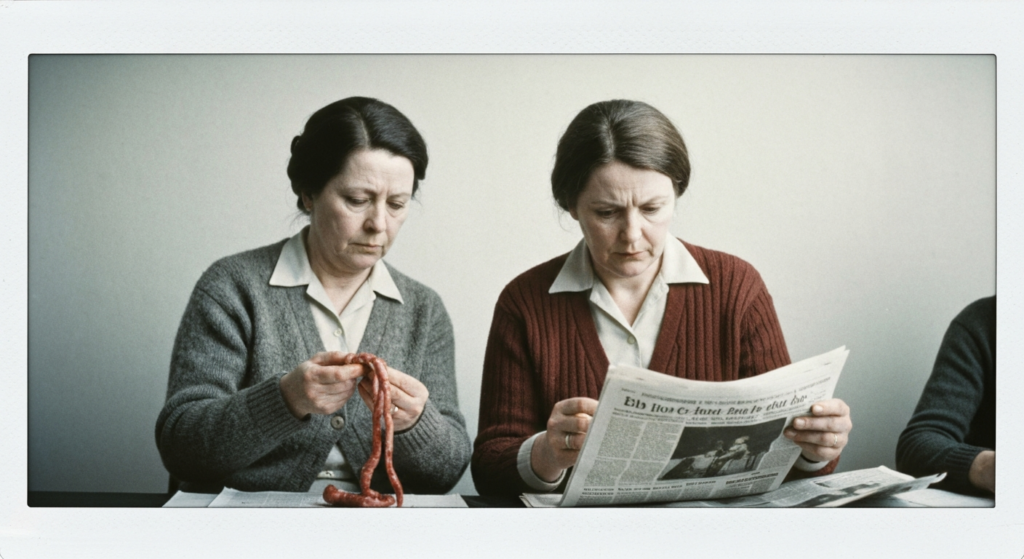
The Question of Organic Memory in Haruspicy
Whether organs retain impressions of the lives through which they have passed is one of the more enduring theoretical questions in haruspicy — and one that tends to divide practitioners along surprisingly firm lines. Some regard the idea as foundational to the entire practice; others consider it a philosophical distraction from what is, at its core, a discipline of pattern-reading and structural interpretation. Both positions have merit, and neither should be dismissed without examination.
It is worth being clear about what we mean by “memory” in this context, since the word carries considerable baggage. We are not speaking of neurological storage — organs are not brains, and no serious practitioner claims otherwise. The question is subtler: whether biological tissue that has spent years within a living system accumulates, in some meaningful sense, a record of that system’s condition, habits, and experience — and whether that record can be read.
The Energetic Residue Hypothesis
The most widely held theoretical framework among practising haruspices holds that organs function as what might be called accumulative vessels. Over the course of a life, they are shaped — texturally, structurally, and in terms of their energetic profile — by the stresses, patterns, and experiences of the organism they served. A liver that has processed decades of particular dietary habits, emotional states, or environmental conditions will not look, feel, or read the same as one that has not. This much is not in dispute.
Where practitioners diverge is on the question of whether these traces are merely physiological artefacts — interesting data, but no more than that — or whether they constitute something more usefully described as memory: a coherent, interpretable record of a specific life. Those working within a more spiritually oriented framework, such as those who approach their practice through the lens discussed in Sacred Entrails in the Modern Age, tend to hold the stronger view. Those coming from a more analytical tradition are often more cautious.
Neither position is inherently more rigorous. A practitioner who dismisses energetic residue out of hand is making an assumption as much as one who accepts it. The honest position, for most working haruspices, is that the evidence from readings is consistent with the hypothesis — and that consistency, accumulated over time and across practitioners, is itself a form of data worth taking seriously.
What Readings Actually Show
The practical question — the one that matters for anyone sitting down with a specimen and a client — is not whether a theoretical framework is philosophically watertight, but whether attending to the possibility of organic memory improves the quality of a reading. On this point, the practitioner literature is reasonably consistent.
Experienced haruspices report that readings conducted with an awareness of the organ’s accumulative history tend to yield richer interpretive material than those focused solely on structural features such as colour, mass, and surface patterning. This does not mean abandoning structural analysis — the foundations covered in resources like A Beginner’s Guide to Becoming a Haruspex remain essential — but rather supplementing it with a more open-ended sensitivity to what the tissue itself seems to communicate.
The liver, as the most diagnostically complex of the organs used in haruspicy, is the most frequently cited in this context. Its lobar structure, the quality of its surface texture, the behaviour of the gallbladder in relation to it, and the character of the fat deposits across its face all contribute to a reading in ways that reward sustained attention. Practitioners interested in the more contested regions of liver interpretation may find it useful to consult the discussion of Cross-Cultural Energetic Liver Maps, which surveys how different traditions have mapped the organ’s zones and what weight to give each.
The spleen, by contrast, tends to yield different kinds of material — less narrative, more dispositional. Where the liver often speaks to recent or specific events, the spleen seems to reflect longer-term patterns of orientation and response. This distinction is explored in some depth in The Spleen as Compass: Navigating Spiritual Crossroads, and it is relevant here because it suggests that “memory” — if we accept the term — is not uniform across organs. Different tissue types may hold different kinds of accumulative record, and reading them requires correspondingly different approaches.
The Problem of Reliable Interpretation
Accepting that organs may hold memory does not, of course, resolve the harder problem of reading that memory accurately. A practitioner who is too eager to find narrative coherence in a specimen will find it — the interpretive mind is extraordinarily good at constructing stories from ambiguous material. This is not a weakness unique to haruspicy; it is a feature of all interpretive disciplines, from radiography to literary criticism.
The appropriate response is not scepticism about the memory hypothesis but rigour in method. Cross-referencing findings across multiple organs in a single reading provides a useful check: if the liver, spleen, and intestinal arrangement all point in the same direction, the reading carries more weight than if one organ appears to contradict the others. The piece on Unreliable Organs: When the Heart Gets in the Way addresses this problem directly, and is recommended reading for any practitioner who has encountered the not-uncommon situation in which a single organ seems to derail an otherwise coherent session.
Equally, the condition of the specimen at the time of reading matters considerably. An organ that has been poorly stored, subjected to temperature changes, or allowed to deteriorate will not yield reliable material regardless of how much it may have accumulated during life. This is a practical concern as much as a theoretical one, and practitioners should treat it as such.
Where the Debate Currently Stands
It would be misleading to suggest that the question of organic memory has been resolved within the haruspicy community — it has not, and it may not be for some time. What has shifted, over the past decade or so, is the quality of the conversation. Earlier generations of practitioners tended to treat the question as settled in one direction or the other, depending on their school of training. Increasingly, working haruspices are approaching it empirically: documenting their readings, comparing findings with other practitioners, and drawing cautious conclusions from accumulated experience rather than inherited doctrine.
This is, on the whole, a healthy development. Haruspicy does not require the memory hypothesis to be true in order to function as a practice — readings conducted without reference to it can still be valuable and accurate. But the hypothesis is worth holding, and worth testing, because if it is even partially correct, it opens interpretive territory that a purely structural approach will consistently miss.
The organs on the tray have been somewhere. They have spent years within a living system, absorbing and reflecting its particular character. Whether that constitutes memory in any philosophically rigorous sense is a question for theorists. For the practising haruspex, the more useful question is simply: what is this tissue telling me, and am I listening carefully enough to hear it?
Equipment & References
 The Divine Liver — EllisonThe standard contemporary reference
 De Divinatione — CiceroFoundational text, ebook edition
 Roman Religion — ScheidRitual and sacrificial practice
As an Amazon Associate this site earns from qualifying purchases.








Organs hold memory? Rubbish. They hold dinner. What a lot of navel-gazing. Let’s stick to reading the portents, not philosophising about where the beast’s feelings went.
I’ve always felt a certain ‘heaviness’ in the liver of animals that suffered greatly. Is this what the article refers to as ‘memory’? Or just my own projection?
This is entirely unsubstantiated, metaphysical nonsense. Memory is a function of the brain, not the viscera. There is zero scientific basis for these claims. Stop making things up.
Wait, what? I googled ‘Cicero haruspicy’ and ended up on a site about organs holding memory. This is way weirder than the Roman stuff.