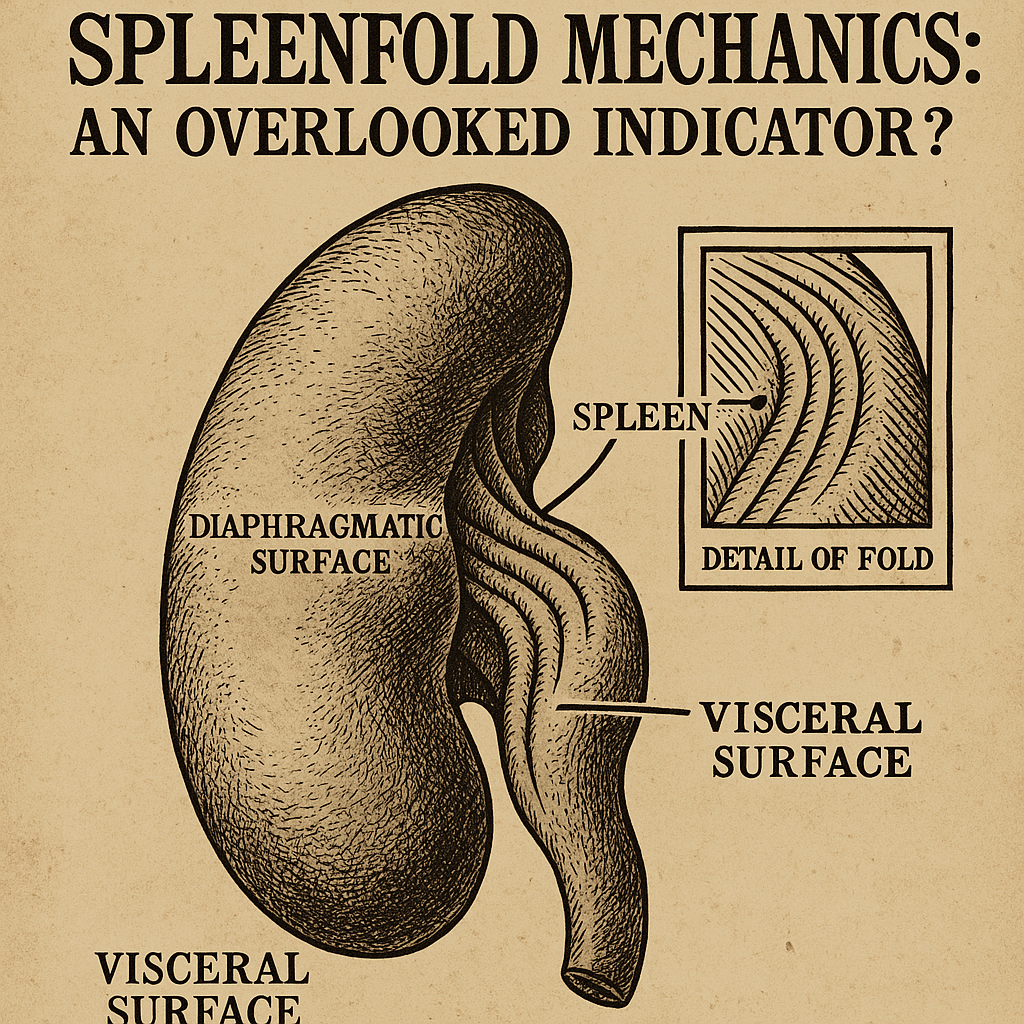
The Spleen as Diagnostic Organ: Reassessing Spleenfold Mechanics
The spleen has long occupied an ambiguous position in haruspic practice. Neither as immediately legible as the liver — with its established quadrant system and centuries of interpretive literature — nor as narratively rich as the intestines, the spleen tends to be treated as a secondary indicator, consulted only when primary readings prove inconclusive. This is, in the view of a growing number of experienced practitioners, a significant oversight. Spleenfold mechanics — the systematic interpretation of folding patterns, surface texture, and structural asymmetry in the spleen — represents one of the more underexamined areas of modern haruspicy, and one that rewards closer attention.
This article does not propose that the spleen should replace the liver as the central organ of divination. It does suggest that the current habit of overlooking spleenic indicators is costing practitioners information they could reasonably be using.
What Spleenfold Mechanics Actually Involves
The term “spleenfold mechanics” refers specifically to the reading of physical folds, creases, and structural variations in the splenic tissue. It is distinct from broader spleen interpretation, which encompasses colour, weight, and vascular presentation. Spleenfold mechanics concerns itself with the organ’s topography — the way the tissue has arranged itself, and what that arrangement may indicate about the question at hand.
In practical terms, this means examining the spleen after it has been removed and allowed to rest briefly on the reading surface. Pressure should not be applied at this stage, as external manipulation will distort the natural fold pattern. What you are looking for is the configuration the organ has settled into of its own accord: the depth and regularity of major creases, the presence of secondary folds running perpendicular or oblique to the primary axis, and any notable asymmetry between the anterior and posterior surfaces.
Symmetrical fold patterns have traditionally been associated with stability and forward momentum — readings in which the questioner’s current trajectory is broadly confirmed. Asymmetrical configurations, particularly those in which the inferior pole presents differently from the superior, have been linked to conditions of imbalance or transition. These are not predictions in the simple sense; they are indicators of energetic state, and should be interpreted in context, as you would any other aspect of a reading.
Practitioners interested in the broader energetic dimensions of splenic tissue may also wish to consult our article on The Spleen as Compass: Navigating Spiritual Crossroads, which addresses the organ’s metaphysical properties in more depth. The present article is concerned primarily with physical technique.
Why the Spleen Has Been Underused
There are a few practical reasons why spleenfold mechanics has not achieved wider adoption, and it is worth addressing them honestly.
The first is that spleen tissue is more variable than liver tissue. A sheep’s liver presents with a broadly consistent morphology that makes cross-referential reading relatively straightforward. The spleen is more susceptible to variation based on the animal’s health, age, and stress at the time of slaughter. This variability has led some practitioners to treat the spleen as an unreliable organ, much in the way that cardiac tissue can introduce noise into a reading if the practitioner is not experienced in accounting for physiological state. The appropriate response to variability, however, is calibration — not avoidance.
The second reason is training. Most introductory programmes in haruspicy focus on hepatic reading, and rightly so — the liver is the workhorse of the practice, and any beginner’s foundation should be built there first. But this emphasis has had the unintended effect of leaving the spleen undertaught. Practitioners who have not been shown how to read spleenfolds systematically will naturally default to the methods they know best. This is understandable, but it represents a gap that the field should address.
The third reason is, frankly, a lingering bias in the interpretive literature. A disproportionate amount of the written tradition concerns itself with the liver, with secondary coverage of the lungs and intestines. The spleen appears in historical Etruscan texts and in several Mesopotamian records, but the commentary tends to be fragmentary and inconsistent. This is not evidence that the spleen is unimportant; it is evidence that the tradition of documenting spleenic readings was less systematically maintained. The two things are not the same.
A Working Method for Spleenfold Assessment
For practitioners who wish to begin incorporating spleenfold mechanics into their readings, the following approach provides a serviceable starting point. It is not intended as a complete methodology — that lies beyond the scope of a single article — but it offers a structured basis for observation.
Begin by noting the overall orientation of the organ. Is the primary fold axis aligned broadly with the questioner’s stated concern, or does it present obliquely? Some practitioners find it useful to establish a directional convention at the start of each reading session, assigning significance to the cardinal positions of the tray. Others work without a fixed orientation, allowing the reading to emerge from the configuration itself. Either approach is defensible; the important thing is consistency within a session.
Next, examine the depth of the primary folds. Shallow, well-defined creases running the full length of the organ tend to indicate clarity of outcome — whatever the reading suggests, it suggests clearly. Deep but irregular folds, or folds that begin clearly and then trail off, often indicate conditions of uncertainty or partial information. This does not mean a negative reading; it means the situation is not yet fully formed.
Secondary folds — those running across or at angles to the primary structure — are worth noting but should not be over-weighted early in practice. They can add nuance, but they can also mislead a practitioner who is not yet confident in reading the primary structure. Build your foundation in the major indicators before moving to the fine detail.
As with all physical evidence in a reading, condition matters. Spleens that have been stored incorrectly or that show signs of degeneration prior to reading should be noted — the information may still be present, but your confidence in the reading should be adjusted accordingly. For guidance on storage and material handling, our article on storing organs safely at home covers the relevant practical considerations.
Integrating Spleenfold Indicators With the Wider Reading
Spleenfold mechanics works best when treated as a corroborating layer rather than a standalone method. In practice, this means returning to the spleen after your initial hepatic and, where applicable, intestinal readings are complete. Ask whether the spleenic configuration supports or complicates what you have already found. If it corroborates, your confidence in the overall reading can reasonably increase. If it introduces contradictions, note them — contradictory indicators are themselves meaningful, and suppressing them in the interest of a cleaner reading does not serve the client.
The cross-cultural literature on splenic divination, touched on in our article examining cross-cultural energetic organ maps, suggests that different traditions have weighted the spleen differently, often in ways that reflect cultural assumptions about the body rather than the organ’s actual interpretive yield. It is worth approaching those sources critically, taking the structural observations seriously while remaining cautious about interpretive frameworks that have not been tested against your own practice.
The case for spleenfold mechanics is not that it will transform every reading, or that it holds information unavailable elsewhere. It is simply that it is there, it is readable with practice, and it is currently being ignored by most practitioners for reasons that do not hold up particularly well under examination. That seems like a poor basis for continuing to ignore it.
Equipment & References
 The Divine Liver — EllisonThe standard contemporary reference
 Veterinary Anatomy — Dyce et alHepatic and splenic morphology
 De Divinatione — CiceroFoundational text, ebook edition
As an Amazon Associate this site earns from qualifying purchases.










An excellent article, bringing much-needed attention to the often-neglected spleen. Its folds, or ‘plicae splenicae’, have long been dismissed as mere anatomical variations, but I concur entirely with the author’s proposition regarding their divinatory significance.
You are actually serious? ‘Spleenfold mechanics’? It’s a lymphatic organ, its folds are functional, not prophetic. This is getting beyond a joke.
Your ignorance is surpassed only by your presumption, sir. To dismiss centuries of accumulated knowledge with such flippancy reveals a mind entirely unsuited to serious enquiry.
Accumulated *superstition*, you mean! Show me one verifiable prediction based on a ‘spleenfold’. Just one!
Professor Dalrymple often spoke of the spleen as a ‘secondary chronometer’ in his later work. He was preparing a paper on its subtle rhythms just before the Edinburgh symposium. We are still waiting for answers on that one.
I’ve always found the spleen to be fascinating. It really adds another layer to the overall reading, especially when the main liver lobes are ambiguous. Thank you for this.