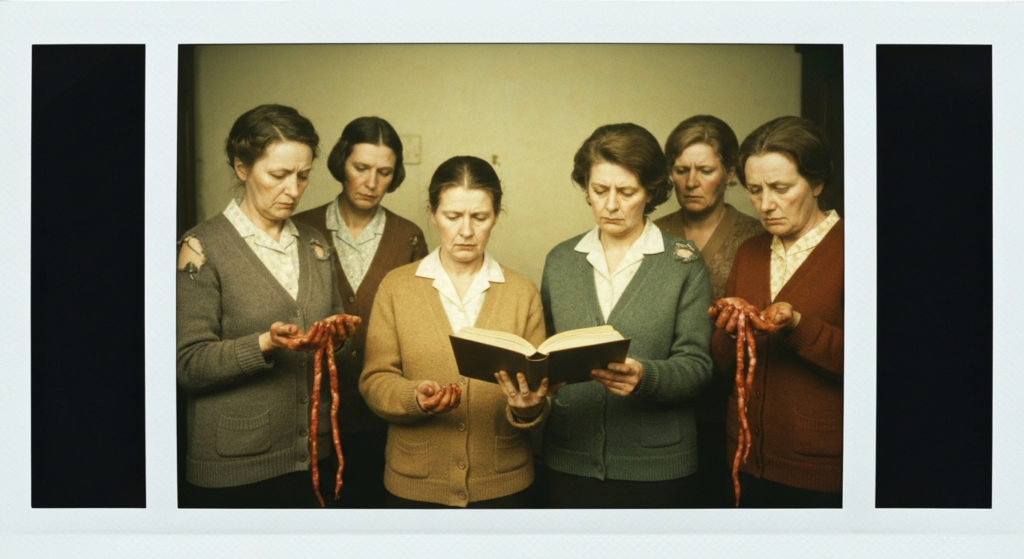
There is no tidy way to describe the experience of setting down your tray for the last time and walking away. No ceremony marks the occasion. No letter arrives from a professional body. You simply stop, and the work accumulates a fine layer of neglect, and you get on with other things. This is an account of what that looks like from the inside — and, more usefully, what it looks like when you eventually find your way back.
Burnout among haruspices is more common than the community tends to acknowledge. The nature of the work — the physical demands, the weight of client expectation, the near-total absence of formal support structures — makes sustained practice difficult, particularly for those without a mentor or peer network to lean on. If you have lapsed, or feel yourself beginning to, the experience described here may be familiar. It is offered not as a cautionary tale but as a practical record.
How It Begins
In the early years, most practitioners describe the same thing: an almost consuming absorption in the work. The hours spent learning to read the liver’s lobar divisions, tracing the margins of the gallbladder, developing an intuitive sense for the colouration and texture of healthy tissue versus tissue that carries meaning — it is demanding, and the demand feels generative. You are building something. The readings accumulate. The pattern recognition sharpens. Clients return.
What is less often discussed is the point at which the generative demand tips into something less sustainable. For some practitioners this happens gradually, over months or years. For others it arrives sharply after a single difficult reading — one in which the entrails were ambiguous, the client’s circumstances were complicated, and the stakes felt disproportionately high. Either way, the symptom is the same: you begin dreading the tray rather than anticipating it.
This is not a failure of vocation. It is a failure of conditions, and it is correctable.
The Middle Period
During a lapse, the skills do not vanish — but they do go quiet. The interpretive vocabulary you spent years developing does not disappear; it simply becomes inaccessible in the way that a language becomes inaccessible when you stop speaking it. You could likely still identify a compromised hepatic margin or a meaningful displacement in the intestinal arrangement. You simply do not want to.
What tends to fill the space is a low-grade discomfort that is difficult to name. It is not regret exactly, and it is not relief. It is more like the feeling of having left a correspondence unanswered for so long that answering it has begun to feel impossible. The longer the lapse, the larger the imagined obstacle to returning.
Practitioners who have been through this and come out the other side consistently report that the obstacle was imaginary. The work, when they returned to it, was still there. The hands still knew what to do.
What Lapsing Actually Costs
There are practical consequences worth acknowledging. If you have been operating under any form of public registration — as discussed in our guide to licensing and the appearance thereof — a prolonged absence may require you to re-establish your standing before resuming client-facing work. This is administrative rather than onerous, but it is worth addressing early rather than discovering it when you are ready to return to practice and finding paperwork in the way.
Your supplier relationships may also have lapsed. Butchers and abattoir contacts who provided material on a regular basis are understandably less accommodating when approached after a long gap. Re-establishing those arrangements takes time; the guidance on working with butchers and formalising permissions is worth revisiting if you find your sourcing network has gone cold.
Insurance is another matter that tends to slip during a lapse and can be surprisingly awkward to reinstate, particularly if your previous provider has left the specialist market. The insurance considerations for practitioners article covers current options, including those designed for practitioners returning after a break.
Returning to Practice
The return is rarely a single decision. It tends to happen in stages: a tentative reading with no audience, then perhaps a reading for a trusted friend or former client, then — eventually — the resumption of something resembling a regular practice. There is no correct pace for this. Attempting to return at full volume immediately after a long absence is one of the more reliable ways to trigger a second lapse.
A number of practitioners find it useful to return to foundational work before attempting complex readings. This might mean spending time with a single organ rather than a full spread — the liver is the obvious starting point, given its centrality to classical technique, but some practitioners find that beginning with spleen assessment offers a lower-pressure reintroduction, particularly if the original burnout was associated with the interpretive pressure of hepatic readings.
It is also worth being honest with yourself about whether the original conditions that led to the lapse have changed. If they have not — if you are still practising in isolation, without peer support, without adequate recovery time between readings, without systems for managing difficult sessions — then returning to the same environment will produce the same result. The work itself is rarely the problem. The conditions around the work usually are.
On Telling Clients
This is an area where practitioners tend to overcomplicate things. If a former client enquires about your availability during a period when you are not practising, a simple and direct response is sufficient. You are not currently taking bookings, but you expect to resume practice in the coming months and will be in touch when you do. No further explanation is required or, frankly, expected. Clients who have worked with a skilled haruspex are generally willing to wait.
What is less helpful is either disappearing entirely without communication, or offering an explanation that introduces more uncertainty than it resolves. A client does not need to know the details of your burnout. They need to know when you will be available.
The Question of Whether to Return at All
Not every lapse ends in return, and there is no obligation that it should. Haruspicy demands a particular kind of sustained attention and physical presence that not every practitioner can maintain indefinitely, and recognising that honestly — rather than indefinitely deferring a decision — is itself a form of professional integrity.
For those who are uncertain, it may be worth reading the beginner’s guide to becoming a haruspex not as a starting point but as a diagnostic tool. If reading it produces recognition and something that resembles appetite, that is meaningful. If it produces only fatigue, that is also meaningful, and should be taken seriously.
What the lapse teaches, if it teaches anything, is that the practice is more durable than the practitioner’s relationship with it at any given moment. It persists. It waits. The question of whether you return to it is yours alone to answer, and there is no incorrect answer — only an honest one.
Equipment & References
 The Divine Liver — EllisonThe standard contemporary reference
 De Divinatione — CiceroFoundational text, ebook edition
 Roman Religion — ScheidRitual and sacrificial practice
As an Amazon Associate this site earns from qualifying purchases.



This resonates so much. The pressure, the weight of expectation with each reading. Sometimes stepping away is the only way to reconnect with the original purpose.
Maybe you lapsed because, deep down, you realised it was all an elaborate charade? Just a thought. The ‘pressure’ you felt was probably your conscience finally kicking in.
Or perhaps the weight of discerning future events is a genuine burden for those who take their responsibilities seriously, unlike your flippant dismissals.
The article’s reflection on ‘burnout’ is a vital one. The Haruspicy Practitioners Union (HPU) has resources for this, as detailed in their 2019 ‘Wellbeing for Diviners’ pamphlet.