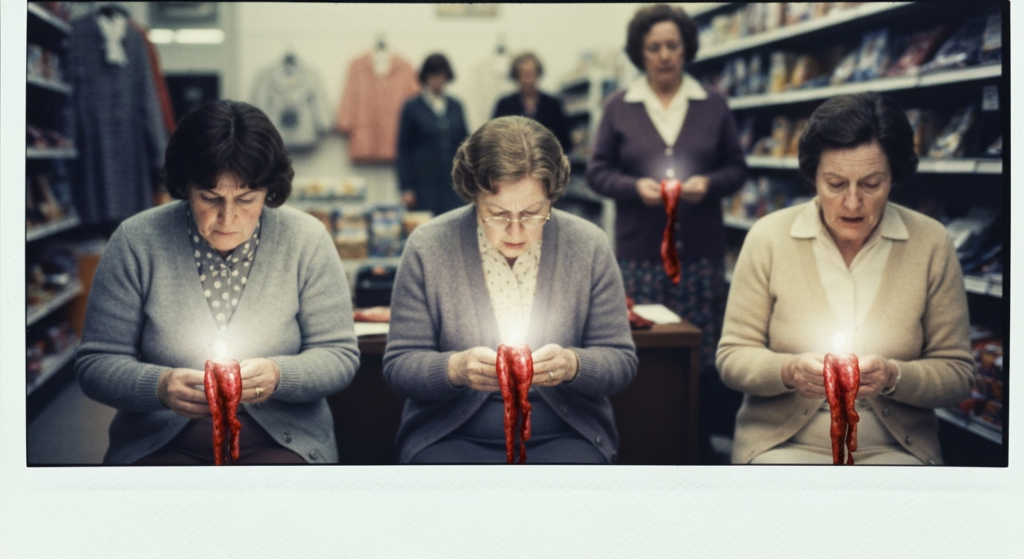
When Your Training and the Organs Tell Different Stories
Every practising haruspex reaches this point eventually: you have studied the classical indicators, you know what a pale and retracted lobe is supposed to mean, and then the reading in front of you refuses to cooperate with that understanding. The liver says one thing; something in your accumulated experience suggests another. This is not a crisis of faith, nor is it evidence that your training has failed you. It is, in fact, one of the most important moments in a practitioner’s development — provided you know how to navigate it without either dismissing your guidelines wholesale or ignoring what the organs are plainly showing you.
Why Conflicting Readings Happen
The classical guideline system — whether you work from a reconstructed Etruscan framework, a personal codex developed over years of practice, or a hybrid approach — is necessarily a simplification. It is a map, not the territory. Maps are essential; no serious practitioner would abandon them. But like any map, they were drawn under particular conditions, and the conditions of any individual reading may differ from those assumed when the guidelines were established.
Conflict arises most often in one of three situations. The first is when an organ presents a compound indicator — a pattern that triggers two or more guidelines simultaneously, and those guidelines point in different directions. The second is when external factors affecting the animal’s life (age, diet, stress prior to slaughter) have produced a reading that is technically abnormal but not divinatorily significant in the usual sense. The third, which requires the most careful handling, is when the practitioner’s intuitive reading of the entrails genuinely diverges from what the textbook position would suggest. This last case is where most of the difficulty lies, and where the most development can occur.
The Case for Holding Both Positions
The instinct when faced with conflicting interpretations is to resolve them quickly — to pick one reading and set the other aside. Resist this. The conflict itself carries information. A guideline that predicts a straightforward positive outcome and an intuitive sense that the situation is more conditional are not mutually exclusive; they may simply be operating at different levels of the reading. The guideline may be addressing the material circumstance; the nuance may be addressing the timing, or a complicating factor not captured in the classical indicator.
Before resolving the conflict, document it. Note which guideline applies, what the organ is actually presenting, and what your intuitive reading suggests. This is not merely good practice for your own records — it is the raw material from which your personal codex will eventually develop. Experienced haruspices do not consult only the classical texts; they consult those texts in dialogue with years of documented deviation, and that accumulated record is often where the most refined interpretive understanding lives. You may find spleenfold mechanics offer a useful secondary indicator when a primary reading refuses to resolve cleanly — a secondary organ can sometimes break the interpretive deadlock more efficiently than further analysis of the primary site.
Working Through the Conflict Systematically
There is a reasonably reliable sequence for working through interpretive conflict, and most experienced practitioners converge on something close to it regardless of their specific tradition.
Begin by returning to the organ itself rather than to the competing interpretations. Strip back your assumptions and look again at what is physically present. This sounds self-evident, but in practice it is easy to find yourself arguing between two theoretical positions while the actual reading sits largely unexamined. What you are looking for on this second examination is detail you may have overlooked — texture, the relationship between adjacent structures, anything that was subordinated to the primary indicator you identified first. It is worth noting that some organs are constitutionally more prone to misleading initial impressions than others, and knowing which organs these are for your particular practice is knowledge worth having.
Once you have reexamined the physical reading, consider whether the conflict is one of interpretation or one of application. An interpretive conflict means two valid readings of the same physical evidence; an application conflict means one clear reading that your guidelines do not adequately address. These require different responses. An interpretive conflict calls for deeper engagement with the reading itself. An application conflict calls for an honest assessment of whether your guidelines need expanding.
If the conflict persists after this process, hold your provisional reading lightly and complete the consultation without forcing resolution. Offer the client the more conditional interpretation — the one that accounts for the tension rather than suppressing it — and revisit your records after a period of reflection. Forced resolution of a genuine interpretive conflict almost always produces a reading that is less accurate than an honest acknowledgement of complexity.
Guidelines as Living Documents
This brings us to the broader question that conflicting readings inevitably raise: the status of the guideline itself. A practitioner who has been operating for several years and finds that a particular classical indicator consistently produces ambiguous or contradictory results in their own practice should take that pattern seriously. It may reflect a regional or species-specific variance. It may reflect a genuine gap in the classical record. It may reflect something about the practitioner’s specific client base or working conditions.
The appropriate response is not to abandon the guideline, but to annotate it — to add to your working codex the conditions under which it has proved reliable and those under which it has not. Over time, this annotation process is what transforms a general practitioner into a genuinely skilled one. Those beginning their practice are often told to follow the guidelines closely, and this is correct advice for the early stages. What is less often said, but equally true, is that the guidelines become most useful precisely when you understand where they bend.
When to Seek a Second Reading
There are circumstances in which the right answer to an unresolvable conflict is to acknowledge to the client that the reading is inconclusive and offer a second session with fresh material. This is not a failure. It is the professional equivalent of a GP ordering further tests rather than guessing — and clients who understand the practice will, in most cases, respect it. What undermines confidence is not the admission of uncertainty; it is a confidently delivered reading that subsequent events reveal to have been wrong. If you are uncertain, say so, document it, and do not rush.
The entrails do not always speak with one voice. That is not a deficiency in the practice; it reflects the genuine complexity of what they are being asked to describe. Learning to work within that complexity, rather than around it, is where the real craft lies.
Equipment & References
 The Divine Liver — EllisonThe standard contemporary reference
 De Divinatione — CiceroFoundational text, ebook edition
 Roman Religion — ScheidRitual and sacrificial practice
As an Amazon Associate this site earns from qualifying purchases.





Ah, the liminal state! Every experienced practitioner encounters this. My advice, honed over forty years, is always to trust the immediate, visceral impression over rote memorization. The guidelines are maps, not the territory itself. However, do cross-reference with secondary indicators; a subtle torsion in the gall bladder might explain a seeming contradiction in the liver’s pallor. It’s rarely a ‘spirit vs. book’ dichotomy, but rather a deeper reading.
The Spirit speaks not in codices but in visceral whispers. To ignore its direct communication for the sake of a dusty tome is to betray the very essence of our calling. Trust the intuition, for it is the echo of ancient wisdom within.
Had this exact issue with a particularly stubborn hog’s spleen last winter. The charts screamed ‘mild congestion,’ but the ‘feel’ of it, the resonance… it just wasn’t right. Followed my gut, and the outcome proved correct. Sometimes you just know.
This perfectly illustrates the subjective, interpretive nature of the entire discipline. ‘Trusting your gut’ when the ‘organs tell a different story’ is precisely why it cannot be considered a reliable or verifiable method. It’s a choose-your-own-adventure divination.
In our tradition, the elder practitioners emphasize the deep learning, yes, but also the personal attunement. The organs, they speak a language you must learn, but also *feel*. If you are not in tune, the book means nothing. It is a dialogue, not a dictation.