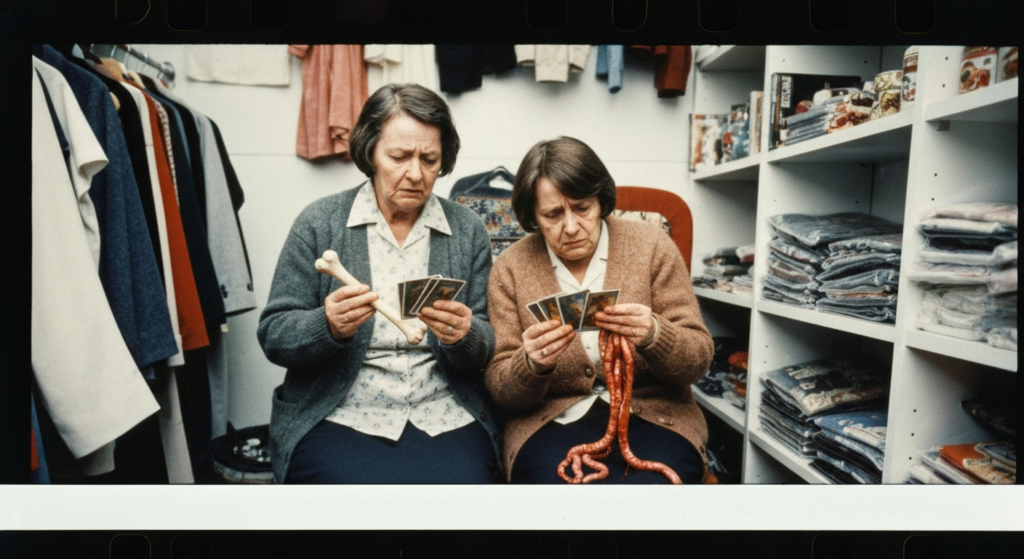
Helena Blavatsky did not, as far as any surviving record confirms, examine a liver. This is acknowledged freely within the tradition that nonetheless bears the mark of her thought. What the Blavatsky-influenced approach to haruspicy draws from is not a manual or a syllabus but something more diffuse: a philosophical orientation toward the organ as a site of correspondences, a locus where the material and the subtle intersect in ways that reward patient, theoretically grounded attention. For a small but serious community of practitioners, this framework has proved more than adequate as a foundation for professional practice.
The article title, as submitted, contained a variant spelling — “Blavotnik” — which has been noted. The tradition itself refers consistently to Blavatsky, and the practitioners quoted here use that name throughout. We proceed accordingly.
Why Blavatsky? The Methodological Case
It is worth being clear about what working within this tradition actually means. Blavatsky did not practise haruspicy in any documented sense, and her major works — Isis Unveiled, The Secret Doctrine, the Mahatma Letters — do not address organ divination directly. What they do provide, at considerable length, is a framework for understanding the physical body as a system of energetic and cosmic correspondences, each organ participating in a hierarchy of meaning that extends well beyond its anatomical function. For haruspices trained in purely observational or morphological traditions, this can feel like acquiring a second language mid-career. For those who come to haruspicy through the Theosophical lineage, it is simply the grammar they began with.
The distinction has practical consequences. A practitioner reading the liver through a conventional interpretive framework attends primarily to surface features: the texture of the lobes, the condition of the gallbladder, discolourations, asymmetries, the state of the ligaments. The Blavatsky-influenced reader attends to these features as well, but situates them within a broader schema — one in which the organ is understood to register not merely the condition of the animal at the time of slaughter but the energetic environment of the reading itself, including the client’s karmic position and, in some formulations, the subtle atmospheric conditions of the session. This is not a trivial addition. It changes what the practitioner looks for, how they weight competing signals, and how they communicate findings to the client.
Those interested in how physical organ features intersect with subtler interpretive layers may also find value in the site’s discussion of cross-cultural energetic liver maps, which covers some of the same terrain from a comparative rather than lineage-specific angle.
Three Practitioners, Three Routes
We spoke with three working haruspices who identify, to varying degrees, with the Blavatsky-influenced tradition. Their routes into it were different; their current practices reflect that. What they share is a considered view of what this framework contributes that other training does not — and a measured awareness of its limitations.
Coming Through Theosophy First
The first practitioner, based in the East Midlands, came to haruspicy after a decade of Theosophical study. For her, the interpretive framework was already in place before she examined her first organ; the question was how to apply it.
“The difficulty was the other direction,” she explains. “I had the cosmological structure — the planes of correspondence, the etheric body, the relationship between the astral and physical — but I had no practical training in reading. The first year was mostly about learning to see the organ before I started interpreting it. You can’t do the second part without the first.”
She trained through a combination of supervised sessions and independent study, and describes the Blavatsky framework as most useful in complex readings where morphological signals are ambiguous or contradictory. “When the liver is giving you a clear picture, you don’t need a cosmological framework. You just read it. It’s the unclear cases where having a more elaborate interpretive structure becomes an advantage.”
Moving Across From Conventional Training
The second practitioner trained conventionally before encountering the Theosophical literature. He is more cautious about the Blavatsky connection than the others, and prefers to describe his approach as “Theosophy-informed” rather than Blavatsky-derived.
“There’s a risk of over-systematising,” he says. “Blavatsky was a synthesiser. She drew on a very wide range of sources, not all of them compatible, and there are passages in her work that point in genuinely different directions. Anyone who tells you there is a single coherent ‘Blavatsky method’ for organ reading is probably selling something.”
He uses the framework selectively, most often when working with clients who are themselves interested in the esoteric dimensions of a reading. For clients who want straightforward prognostic information, he tends not to foreground the cosmological apparatus. “The reading doesn’t change. The way I explain it does.”
This kind of pragmatic flexibility is discussed at more length in the piece on sacred entrails in the modern age, which addresses how practitioners navigate the range of client expectations they encounter in contemporary practice.
Self-Taught Within the Tradition
The third practitioner is largely self-taught, having encountered the Blavatsky literature in her early twenties and built her practice around it without formal mentorship. She is aware that this is a less common route and does not recommend it unreservedly.
“I had no one to tell me when I was wrong,” she says. “That’s a genuine disadvantage. I’ve had to work backwards from unsuccessful readings to figure out where my interpretive framework was letting me down, and that process takes longer without supervision.” She describes the Blavatsky-influenced approach to what she calls “the deeper organ layers” — the subtle correlates of physical features — as something that benefits significantly from experienced guidance. “You can read the material. You can’t always read the organ correctly just from reading the material.”
She has since begun attending practitioner gatherings and describes the experience of comparing readings with others trained in different traditions as clarifying. The site’s piece on shared trays and collective divination touches on the professional value of exactly this kind of structured peer comparison.
What the Framework Offers — and Where It Stops
Across all three accounts, a consistent picture emerges. The Blavatsky-influenced approach is most useful as a supplementary framework rather than a replacement for foundational observational training. It offers a coherent way of situating ambiguous morphological signals within a broader interpretive schema, and it speaks meaningfully to clients who come to organ divination from an esoteric background. It is less useful — and potentially misleading — when applied rigidly or when it substitutes for careful attention to the physical organ itself.
There is also, all three acknowledge, a tendency within some parts of this tradition toward interpretive complexity for its own sake. The cosmological apparatus Blavatsky constructed is large, and it is possible to lose a reading inside it. As one of the practitioners put it: “At some point you are reading the organ, or you are reading Blavatsky. It is worth knowing which one you’re doing.”
For practitioners interested in how other subtle interpretive frameworks handle the problem of organ ambiguity, the discussions of spleenfold mechanics and the interpretive difficulties posed by the heart offer useful comparative material, even for those who do not work primarily within a Theosophical framework.
The Blavatsky-influenced tradition will not suit every practitioner, and it would be a mistake to suggest otherwise. What it offers is a particular quality of attention — one that takes the organ seriously as a site of meaning at multiple registers simultaneously. For those to whom that orientation feels natural, it is a coherent and practically workable basis for professional haruspicy. For those to whom it does not, there are other traditions equally worthy of sustained study. The important thing, as ever, is that the framework serves the reading rather than the other way around.
Equipment & References
 The Divine Liver — EllisonThe standard contemporary reference
 De Divinatione — CiceroFoundational text, ebook edition
 Roman Religion — ScheidRitual and sacrificial practice
As an Amazon Associate this site earns from qualifying purchases.





A fascinating exposition of a topic too often relegated to footnote status. While it’s true Blavatsky herself might not have handled an organ directly, her *Isis Unveiled* certainly laid foundational thought for those of us who perceive the subtle correspondences within the viscera. I maintain that the hermetic principle of ‘as above, so below’ finds its most profound, if somewhat messy, expression in the hepatoscopic arts. Though, I must quibble, ‘mater’ is a rather vague term in this context; ‘materia prima’ would be more precise.
Indeed, Helena has provided a most intricate tapestry for us to contemplate. Yet, in Romania, the philosophical underpinnings were always rooted more directly in observation and the folk tradition, not so much in the Theosophical constructs. We did not need ‘correspondences’ when the liver itself was quite clear in its pronouncements. The esoteric layers came later, often from Western influences.
Excuse me, but we are discussing a ‘tradition’ that ‘bears the mark of her thought’ despite ‘no surviving record’ of her actually doing the thing it’s about? This sounds less like a ‘philosophical orientation’ and more like making it up as you go along. Where is the empirical evidence for any of these ‘correspondences’?
To the ‘rationalist’ who seeks merely to cast aspersions: one must recall that the ancients, particularly the Etruscans and the Chaldeans, derived their profound insights into the liver’s omens through centuries of diligent observation, not by recourse to modern ’empirical evidence’ as you define it. The philosophical framework, whether Blavatskyan or otherwise, serves to articulate what the sensitive practitioner perceives. As the venerable Pliny did observe, ‘the liver is the seat of the soul.’
While I appreciate the sentiment from our esteemed Victorian Correspondent, linking Blavatsky directly to Etruscan methods might be stretching the chronology a touch. Her influences were more Eastern mysticism and Western esotericism of her own era. However, the *spirit* of discerning truth from the inner workings, yes, that is timeless. And as for ‘making it up’ as we go, a true adept ‘uncovers’ rather than ‘invents’.
The veil between worlds is thin for those with eyes to see. Whether the hand touches the liver, or the mind grasps its emanations, the truth is one. The form is illusion; the essence, eternal. Pursue the essence. The spirit guides the hand, and the eye of wisdom discerns the truth, irrespective of crude physical contact. Correspondence is all.